Agency contract drafting: step-by-step guide for 2026

Agency contract drafting: step-by-step guide for 2026
Drafting agency contracts sounds straightforward until a missed clause costs you a client, a payment dispute drains your time, or a project spirals out of scope with no legal recourse. Poor contract management can drain 2 to 11% of your annual revenue, and slow turnaround times make the problem worse. Whether you’re a freelancer landing your first retainer or a small agency juggling dozens of client agreements, this guide walks you through every stage of the contract drafting process so you can move faster, protect your business, and stop leaving money on the table.
Table of Contents
What you need to prepare before drafting an agency contract
Step-by-step agency contract drafting process
Troubleshooting, common mistakes, and expert shortcuts
Verifying, signing, and managing agency contracts for ongoing success
Automate and simplify your contract process with LexFlow
Frequently asked questions
Key Takeaways
Point | Details |
|---|---|
Prepare key details | Gather client information, services, and legal clauses before drafting to streamline your workflow. |
Use legal tech for speed | AI and e-signature tools dramatically reduce contract creation and turnaround times without costly legal fees. |
Avoid costly mistakes | Address scope creep and common drafting errors early to protect revenue and ensure clarity. |
Verify and manage contracts | Review, sign, and store contracts securely with management platforms to prevent losses and ensure ongoing success. |
What you need to prepare before drafting an agency contract
Before you open a blank document or fire up a template, you need the right information in front of you. Skipping this step is one of the most common reasons contracts get revised three or four times before anyone signs.
Here’s what to gather before you start:
Full legal names and contact details for both parties (your business and your client)
Project scope summary including deliverables, timelines, and revision limits
Payment structure covering rates, invoicing schedule, and late payment penalties
IP ownership terms clarifying who owns the work once it’s delivered
Confidentiality requirements especially if the client shares sensitive business data
Contractor status language confirming you’re an independent contractor, not an employee
Termination and dispute resolution clauses so both sides know the exit process
According to freelance contract clause checklist best practices, key clauses include parties’ details, scope of work, payment terms, IP ownership, confidentiality, independent contractor status, termination, and dispute resolution. Miss any of these and you’re exposed.
Once you have this information ready, the next decision is how you’ll actually draft the contract. Here’s a quick comparison:
Method | Time to draft | Error risk | Cost |
|---|---|---|---|
Manual (Word/Google Docs) | 3 to 8 hours | High | Low upfront, high risk |
Lawyer-drafted | 1 to 5 days | Low | $300 to $1,500+ per contract |
Legal tech platform | Under 1 hour | Low | Affordable monthly fee |
For most freelancers and small agencies, automated contract drafting tools hit the sweet spot between speed, accuracy, and cost. You get legally sound language without the lawyer invoice.
Pro Tip: Before drafting, create a one-page client intake form that captures all the details above. This cuts your prep time in half and ensures nothing gets missed when you start building the actual agreement.
Step-by-step agency contract drafting process
Once you’ve gathered your requirements, you can follow these steps to draft a contract efficiently.
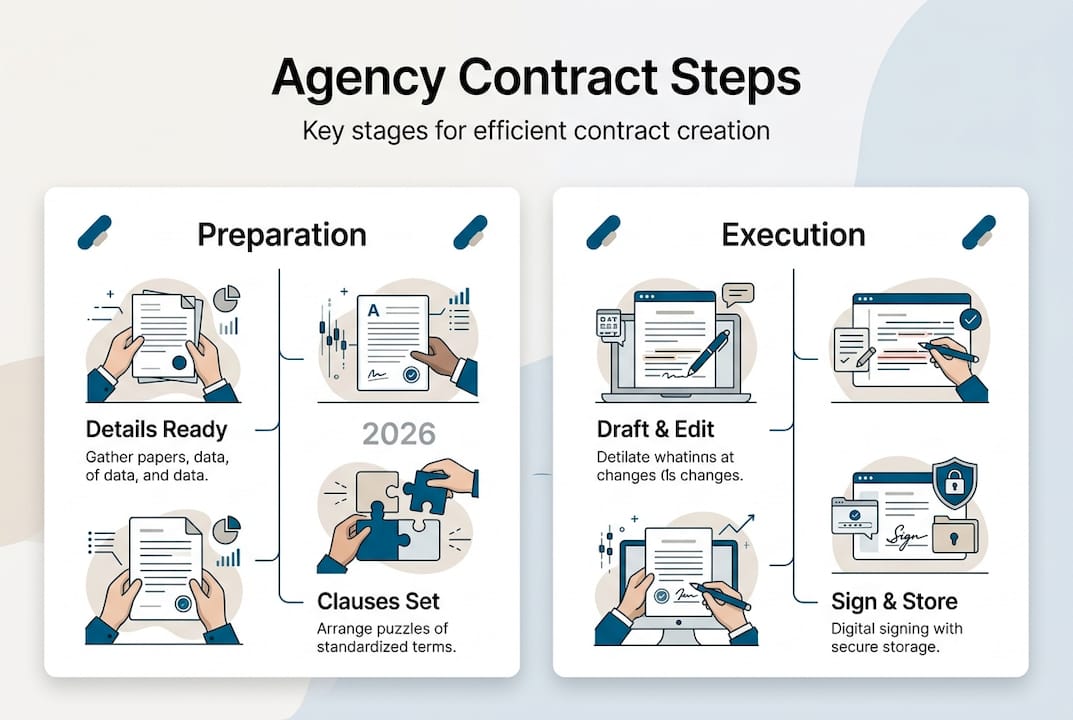
Enter client and project details. Start with the basics: full legal names, business addresses, project title, and start date. These anchor the entire agreement.
Define the scope of work precisely. List every deliverable, format, and deadline. Vague language here is where disputes are born.
Set payment terms clearly. Specify the total fee, payment schedule (milestone or monthly), accepted payment methods, and late fees.
Add IP and confidentiality clauses. State who owns the final work product and what information must stay private.
Include termination and kill fee terms. A kill fee (typically 25 to 50% of the remaining contract value) protects you if a client cancels mid-project.
Review with AI redlining. Use AI-powered contract customization to flag inconsistencies, missing clauses, or language that doesn’t match your jurisdiction.
Send for e-signature. Once reviewed, send the contract digitally. E-signatures reduce turnaround to 24 hours or less, and AI redlining saves 50 to 90% of drafting time.
Here’s a realistic time breakdown when using legal tech versus doing it manually:
Task | Manual time | With legal tech |
|---|---|---|
Drafting initial contract | 3 to 5 hours | 15 to 30 minutes |
Reviewing and revising | 1 to 3 hours | 10 to 20 minutes |
Sending and collecting signatures | 1 to 3 days | Under 24 hours |
Total turnaround | 2 to 5 days | Same day |
Pro Tip: Use a Master Service Agreement (MSA) as your base document for repeat clients. Then attach a short Statement of Work (SOW) for each new project. This way, you only negotiate the big legal terms once and swap out project details as needed.
Platforms with e-signature and AI redlining tools handle the heavy lifting so you can focus on the work itself, not the paperwork.

Troubleshooting, common mistakes, and expert shortcuts
Even with great tools and a clear process, pitfalls can happen. Here’s how to spot and bypass them.
The most frequent mistakes freelancers and agencies make include:
Vague scope of work. If your contract says “social media management” without specifying platforms, post frequency, or content types, you’re inviting scope creep. A detailed SOW prevents scope creep, which can cause up to 33% revenue loss.
No kill fee clause. Without one, a client can cancel after you’ve done 80% of the work and owe you nothing.
Missing payment escalation terms. Contracts should specify what happens after 30, 60, and 90 days of non-payment.
Ignoring jurisdiction. A contract written for one state or country may not be enforceable in another. Always specify governing law.
Skipping NDA language. Even if a client doesn’t ask for it, including a basic confidentiality clause protects both parties.
“AI-powered contract review tools that follow a structured legal playbook consistently outperform generic AI in accuracy and clause coverage, reducing risk for both parties.” Sirion AI research on playbook-driven AI accuracy
For specialized agreements, like influencer partnerships or white-label agency deals, standard templates often fall short. In these cases, use AI-powered agency contracts that let you customize clauses based on your specific industry and jurisdiction without starting from scratch.
Pro Tip: Always include a “changes and amendments” clause that requires written approval for any scope changes. This single clause can save you hours of back-and-forth and thousands in unpaid work.
Verifying, signing, and managing agency contracts for ongoing success
Now, make sure your contracts are signed and managed efficiently for lasting success.
Before you send any contract for signature, run through this verification checklist:
Both parties’ names and details are correct (typos here can invalidate a contract)
All deliverables and deadlines are explicitly listed
Payment amounts, dates, and methods are confirmed
IP ownership is unambiguous
Termination conditions and notice periods are clear
Governing law and dispute resolution method are specified
Once verified, send it for e-signature immediately. Delays between drafting and signing give clients time to renegotiate or walk away.
Key stat: Agencies typically send 30 to 50 contracts per month. Without a system, contract management inefficiency alone can drain 2 to 11% of revenue annually. That’s a significant loss for a business of any size.
After signing, contract management is where most agencies drop the ball. Store every signed agreement in a centralized, searchable location. Set calendar reminders for renewal dates, payment milestones, and termination windows. Review active contracts quarterly to catch any that have drifted out of alignment with current project realities.
Using contract management strategies built into your legal tech platform means you’re not relying on a folder of PDFs buried in your email. You get visibility, alerts, and a clear audit trail if a dispute ever arises. That’s not just convenient, it’s protection.
The agencies that grow consistently are the ones that treat contracts as living business tools, not one-time paperwork. Every signed agreement is a record of your terms, your value, and your professional standards.
Automate and simplify your contract process with LexFlow
By applying these best practices, you’re ready to take things further, especially with tools built for exactly this kind of work.
LexFlow is built for freelancers, agencies, and founders who need professional contracts without the professional legal fees. You can create contracts in minutes using AI-powered templates tailored to your jurisdiction, with plain-English explanations for every clause so you always know what you’re signing. Built-in e-signatures mean your turnaround stays under 24 hours, and secure document storage keeps everything organized and accessible. From first draft to final signature, LexFlow handles the workflow so you can focus on delivering great work. Review our legal contract guidelines to understand how the platform supports your specific needs.
Frequently asked questions
What are the most important clauses to include in an agency contract?
Key clauses include scope of work, payment terms, IP ownership, confidentiality, independent contractor status, termination, and dispute resolution. Missing even one of these can leave your business exposed to financial or legal risk.
How can AI tools speed up the agency contract drafting process?
AI redlining saves 50 to 90% of drafting time, and e-signatures shrink contract turnaround to under 24 hours. Together, these tools can compress a multi-day process into a single afternoon.
How do I prevent scope creep in my contracts?
Write a detailed Statement of Work that lists every deliverable, format, revision limit, and deadline. A detailed SOW prevents scope creep, which can cost agencies up to 33% of project revenue.
Are e-signatures legally valid for agency contracts?
Yes, e-signatures are legally recognized in most jurisdictions and are widely used for commercial agreements. E-signatures reduce turnaround to 24 hours or less, making them both legally sound and practically efficient.
What’s the benchmark for managing agency contracts efficiently?
Agencies typically process 30 to 50 contracts per month. Best practice is using a legal tech platform with e-signatures and centralized storage to avoid the revenue drain that comes from manual mismanagement.