Contract compliance guide: Freelancers & small businesses

Contract compliance guide: Freelancers & small businesses
TL;DR:
Proper contract compliance ensures timely payments, protects intellectual property, and reduces disputes.
Key clauses like scope, payment, IP, confidentiality, termination, and liability require ongoing monitoring.
Combining automated tools with manual review offers the most effective approach for contract management.
Most freelancers and small business owners sign contracts without fully reading them. That’s not laziness. It’s a combination of time pressure, confusing legal language, and the assumption that contracts are just formalities. But missing key contract clauses can expose you to payment delays, lost intellectual property rights, and disputes that drain your energy and your bank account. Contract compliance simply means doing what your contract says, and making sure the other party does too. This guide breaks down exactly what that looks like in practice, with no law degree required.
Table of Contents
What is contract compliance and why does it matter?
Key contract clauses that require compliance
How to ensure contract compliance: Methods and tools
Hidden compliance risks and how to avoid them
Manual vs. automated compliance: What works best?
Our perspective: Demystifying compliance for non-lawyers
Simplify contract compliance with LexFlow
Frequently asked questions
Key Takeaways
Point | Details |
|---|---|
Know your clauses | Focusing on scope, payment, and IP is key to staying compliant and avoiding disputes. |
Leverage technology | Digital tools and reminders simplify compliance and reduce manual errors. |
Don’t rely on generic clauses | Use tailored compliance terms to prevent hidden legal risks and liabilities. |
Hybrid approach works best | Combining automation with human review is the most effective way to manage contracts. |
What is contract compliance and why does it matter?
Contract compliance is the ongoing practice of following the terms you agreed to in a contract, and verifying that the other party does the same. It’s not a one-time event. It starts the moment you sign and continues until the agreement ends.
For freelancers and small businesses, the stakes are real. Non-compliance can mean:
Late or missing payments because invoice terms weren’t followed
Loss of creative ownership when IP clauses weren’t reviewed
Unexpected liability when indemnity sections were skimped over
Breach of contract claims that result in legal fees or lost clients
Damaged relationships from misunderstood expectations
Think of a contract as a rulebook for a business relationship. Both sides agreed to the rules. Compliance means playing by them, consistently.
“A contract is only as strong as the attention paid to it after signing.”
The core clauses in any solid agreement cover scope, payments, intellectual property, confidentiality, liability, and termination. Each one creates a specific obligation. Ignoring even one can create a gap that costs you later.
The business case for compliance is straightforward. When both parties stick to the contract, disputes drop. Payments arrive on time. Clients trust you more because you operate professionally. And you spend less time chasing people or defending yourself.
Good contract management basics start with understanding what you’ve agreed to, not just trusting that things will work out. The sooner you treat compliance as a routine part of your workflow, the less stressful your client relationships become.
Key contract clauses that require compliance
Not all contract clauses carry equal weight. Some are administrative. Others can make or break a project. Here are the six you need to track closely.
Clause | What it covers | Common compliance failure |
|---|---|---|
Scope of work | Deliverables, deadlines, revisions | Scope creep without contract amendment |
Payment terms | Rates, invoicing schedule, late fees | Invoicing late or missing payment triggers |
Intellectual property | Ownership of work product | Assuming you own work you were paid to create |
Confidentiality | What can and can’t be shared | Sharing client data or project details publicly |
Termination | How and when the contract ends | Ignoring notice periods |
Liability and indemnity | Who’s responsible for damages | Signing one-sided indemnity clauses without review |
The key clauses in any freelance or small business contract form the backbone of your legal protection. Miss one, and you may find yourself doing extra work for free, losing ownership of your best creative output, or absorbing costs that should belong to the client.
Scope of work is where most disputes begin. If the contract doesn’t clearly define what’s included, clients can request unlimited revisions or additional deliverables without paying more. Write it specific. List every deliverable. Set a revision limit.

Payment terms need dates, not just amounts. “Net 30” means payment is due 30 days after the invoice. If you don’t invoice on time, the clock doesn’t start. Many freelancers lose weeks of cash flow simply because they didn’t track their own invoicing schedule.
Pro Tip: Add a late fee clause to every contract. Even a 1.5% monthly fee on overdue invoices signals professionalism and motivates faster payment.
Intellectual property is often misunderstood. In many jurisdictions, the creator owns the work by default unless the contract says otherwise. If a client wants full ownership, that needs to be spelled out explicitly, and priced accordingly.
For legal compliance requirements that apply to your specific situation, it’s worth reviewing your contracts against local jurisdiction rules, especially around IP and confidentiality.
How to ensure contract compliance: Methods and tools
Knowing what to comply with is step one. Actually doing it consistently is where most people struggle. Here’s a practical framework.
Centralize all your contracts. Keep every agreement in one place, whether that’s a secure cloud folder or a dedicated contract management platform. If you can’t find a contract quickly, you can’t comply with it.
Assign every obligation a deadline. Go through each contract and list every action required, with a date. Who sends the invoice? When? Who delivers what by when?
Set automated reminders. Use calendar alerts or a task management tool to flag upcoming deadlines at least one week in advance.
Run periodic self-audits. Once a month, review active contracts and check whether all obligations are being met on both sides.
Use contract templates and checklists. Starting from a solid template reduces the chance of missing critical clauses. A review checklist ensures nothing slips through.
Effective digital contract management follows a clear methodology: centralize contracts, assign obligations, use alerts, monitor key performance indicators, conduct audits, apply workflow checklists, and use AI for triage on new agreements.
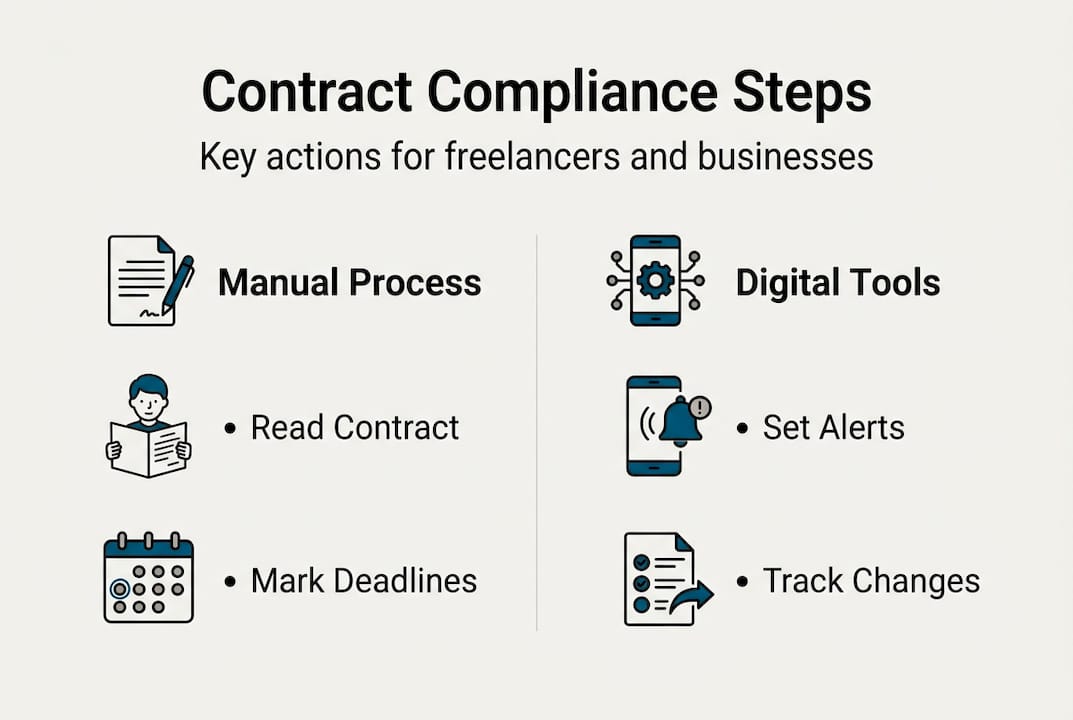
Method | Best for | Limitation |
|---|---|---|
Spreadsheet tracker | Solo freelancers, simple contracts | Manual updates, easy to forget |
Calendar reminders | Deadline tracking | Doesn’t store contract details |
Contract platform | Teams, multiple clients | Small learning curve |
AI-assisted review | Initial screening, clause flagging | May miss context-specific nuance |
One thing many freelancers overlook: common contract review mistakes often come from reviewing a contract once and never returning to it. Contracts are living documents. If the scope changes, the contract should change too.
Pro Tip: Create a one-page compliance summary for every contract you sign. List the top five obligations, key dates, and any clauses that need monitoring. Pin it somewhere visible during the project.
Hidden compliance risks and how to avoid them
Even organized freelancers and small business owners get caught out by risks that aren’t obvious at first glance. These are the ones worth knowing before they become problems.
Vague “comply with law” clauses. A generic clause that says you’ll comply with all applicable laws sounds reasonable. But unclear legal frameworks can leave you exposed if the relevant law isn’t specified. Which law? Which jurisdiction? Which version?
Hidden deadlines buried in boilerplate. Insurance renewal requirements, notice periods, and audit rights often sit in the fine print. Missing them can void protections you thought you had.
Freelancer vs. employee misclassification. This is a major risk in 2026. Misclassification under IR35 or 1099 rules can result in significant fines for both the hiring party and the contractor. If you’re being treated like an employee but classified as a freelancer, that’s a compliance problem.
Inconsistent term definitions. If “deliverable” means one thing in section 2 and something slightly different in section 7, disputes are almost guaranteed. Always check that defined terms are used consistently throughout.
One-sided indemnity clauses. Some contracts require you to indemnify the client for almost anything that goes wrong, even things outside your control. Read these carefully.
“The most expensive contract clause is the one you didn’t read.”
The pattern here is that most hidden risks come from language that seems harmless or standard. Nothing in a contract is truly standard. Every clause was written by someone with a specific intent. Your job is to understand that intent before you sign.
Manual vs. automated compliance: What works best?
There’s an ongoing debate in the freelance and small business world about whether to handle contract compliance manually or lean on technology. The honest answer: both have a role.
Manual review means a human reads every clause, flags concerns, and tracks obligations by hand. It catches nuance, context, and custom language that automated tools can miss. But it’s slow, and 68% of term inconsistencies are missed during manual review alone. That’s a significant failure rate for something as important as legal compliance.
Automation handles repetitive tasks well. AI tools can scan contracts for missing clauses, flag unusual language, and compare terms against a standard template in seconds. They’re particularly useful for initial screening before you invest time in a full review.
But automation has limits. It can miss context-specific risks, cultural nuances in international contracts, and the kind of common human errors that only become obvious when you understand the full business relationship.
Approach | Speed | Accuracy | Best use case |
|---|---|---|---|
Manual only | Slow | Moderate | High-stakes, custom contracts |
Automated only | Fast | High for standard issues | Template-based, routine agreements |
Hybrid | Moderate | Highest | Most freelance and SMB situations |
Pro Tip: Use automation for your first pass on any new contract. Let the tool flag obvious issues and missing clauses. Then do a focused manual review on the flagged sections and any high-value terms like payment and IP.
The hybrid approach is the practical sweet spot for most freelancers and small businesses. Let technology handle the routine work. Reserve your attention for the decisions that actually require judgment.
Our perspective: Demystifying compliance for non-lawyers
Here’s something we’ve noticed working with freelancers and small business owners: the biggest barrier to contract compliance isn’t complexity. It’s fear.
People see legal language and assume they need a lawyer to interpret it. So they either skip reading the contract entirely, or they sign it hoping nothing goes wrong. Both approaches leave you exposed.
The truth is that most contract compliance is organized common sense. Scope of work means do what you said you’d do. Payment terms mean invoice on time and follow up when payment is late. Termination clauses mean give proper notice when you want to exit. None of that requires a law degree.
What it does require is a system. A simple checklist, a calendar reminder, and a habit of reviewing active contracts once a month will handle 80% of your compliance needs. The remaining 20%, the genuinely complex stuff, is when you escalate to a professional.
The mindset shift that matters most: stop treating contracts as paperwork and start treating them as the operating manual for your business relationships. When you read them that way, compliance stops feeling like a legal burden and starts feeling like basic professionalism.
Simplify contract compliance with LexFlow
If the methods above sound useful but time-consuming to set up from scratch, LexFlow was built exactly for this situation.
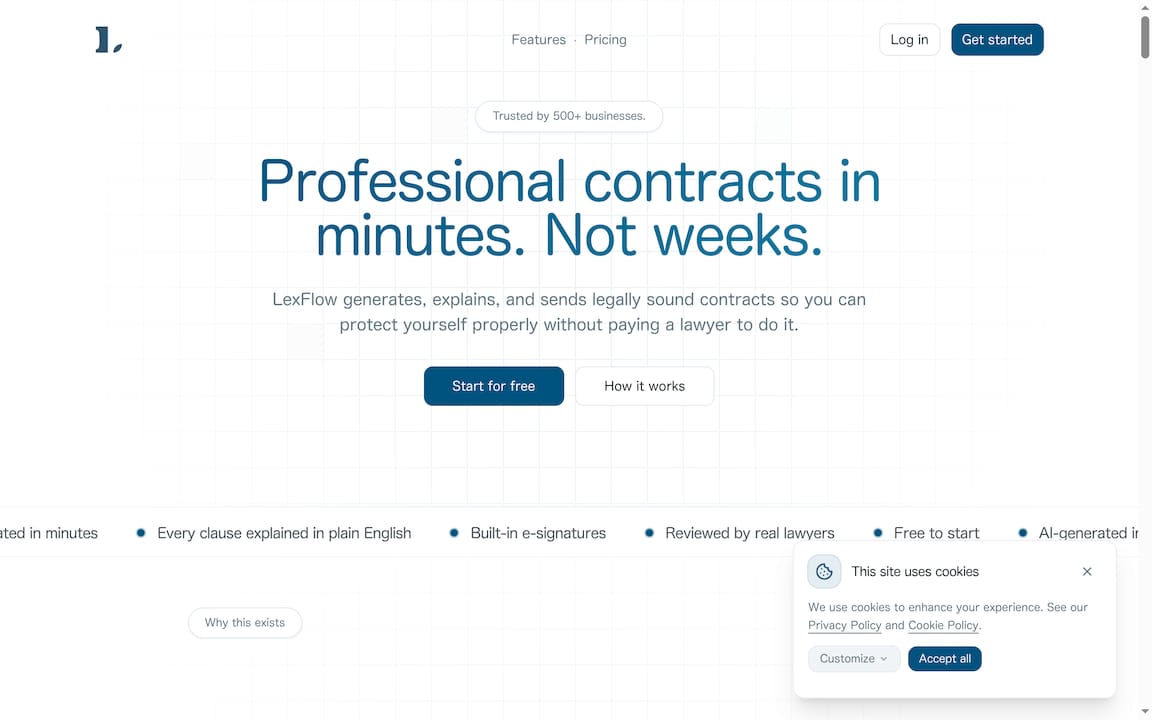
With LexFlow, you can create and manage contracts using AI-powered templates that already include the key clauses covered in this guide, written in plain English so you understand what you’re agreeing to. Built-in e-signatures, automated reminders, and secure document storage mean your compliance workflow runs in the background while you focus on your actual work. And because every clause comes with a plain-English explanation, you’ll always know what you’re signing. Check the legal disclaimer details to understand how LexFlow supports your specific jurisdiction.
Frequently asked questions
What is the first step in contract compliance for freelancers?
Start by reading every contract section carefully, with particular focus on scope, payment, and termination clauses. These three areas cause the most disputes and are the easiest to misunderstand without a close read.
How can I track contract deadlines and obligations easily?
Use digital tools and automated reminders to manage key dates and compliance requirements. A simple calendar system works for solo freelancers, while contract platforms handle more complex tracking for growing businesses.
Are generic ‘comply with law’ clauses enough for legal protection?
No. Generic compliance clauses are ambiguous and can leave you exposed to liabilities you didn’t anticipate. Specific clauses that name the relevant laws and jurisdictions offer far stronger protection.
What’s the most common mistake in contract compliance?
Missing hidden deadlines and misclassification of freelancers as employees are two of the most frequent and costly errors. Both are avoidable with a careful initial review and ongoing monitoring.
Can automation fully replace manual contract review?
No. Automation catches standard errors efficiently, but hybrid manual-automated review is the best practice for minimizing risk. Complex or high-value contracts always benefit from human judgment on the final review.