Contract management explained: Save time and reduce risks

Contract management explained: Save time and reduce risks
TL;DR:
Poor contract management can lead to an 8.6-9.2% revenue loss annually for small businesses and freelancers.
Most contract pitfalls involve auto-renewals, liability caps, IP claims, and unilateral modifications, which can be mitigated through careful review and negotiation.
Affordable digital tools and simple habits like centralized storage and renewal alerts greatly improve contract oversight and prevent costly mistakes.
Poor contract management costs businesses 8.6 to 9.2% of annual revenue every single year. That’s not a problem reserved for Fortune 500 companies with legal departments. Freelancers and small business owners face the same risks, often with far less protection. A missed renewal clause, a vague payment term, or an overlooked liability cap can unravel months of work. This guide breaks down what contract management actually means, walks you through the full lifecycle, exposes the most common and costly mistakes, and shows you practical, affordable ways to take control of your agreements starting today.
Table of Contents
What is contract management and why does it matter?
The contract lifecycle: From initiation to renewal
Common contract pitfalls and how to avoid them
Affordable contract management solutions for freelancers and small businesses
The uncomfortable truth most freelancers and small businesses miss
Unlock easy contract management with LexFlow
Frequently asked questions
Key Takeaways
Point | Details |
|---|---|
Clear contract oversight | Managing contracts systematically prevents costly errors and missed obligations. |
Step-by-step lifecycle | Every contract passes through distinct stages from creation to renewal, and understanding each helps reduce risk. |
Avoid common traps | Auto-renewal clauses and ambiguous terms are frequent pitfalls that can be prevented with careful review. |
Affordable solutions exist | Freelancers and small businesses can use cost-effective software and templates to streamline contract management. |
Simple habits matter | The best protection is setting reminders and using digital tools—no legal degree required. |
What is contract management and why does it matter?
Contract management is the process of overseeing contracts from creation through execution, performance monitoring, compliance, and renewal or termination. It sounds formal, but at its core it’s just making sure every agreement you enter does what it’s supposed to do, and that you don’t get blindsided when something changes.
For freelancers and small business owners, contracts show up everywhere. Client service agreements, vendor deals, lease agreements, subcontractor arrangements. Each one carries obligations on both sides. Without a system to track them, things fall through the cracks fast.
Here’s what happens when contract management is ignored:
Missed renewal deadlines that lock you into unfavorable terms automatically
Unpaid invoices because payment milestones weren’t clearly defined or tracked
Scope creep when deliverables aren’t spelled out in writing
Legal exposure from indemnity clauses you didn’t fully understand
Lost revenue from contracts that quietly expire without renegotiation
The financial impact is real. Businesses lose between 8.6 and 9.2% of revenue annually due to poor contract oversight. For a freelancer earning $80,000 a year, that’s potentially $7,000 gone from avoidable mistakes.
“The biggest contract risks aren’t dramatic legal battles. They’re quiet, slow leaks: a clause you didn’t read, a date you forgot, a term you assumed was standard.”
Here’s a quick look at the cost of neglect versus active management:
Scenario | Impact |
|---|---|
Missed renewal clause | Auto-locked into old rates |
Unclear payment terms | Delayed or disputed invoices |
No performance tracking | Unmet obligations go unnoticed |
Poor document storage | Can’t locate agreements when disputes arise |
No compliance monitoring | Regulatory penalties or contract breaches |
With affordable contract management tools now available, there’s no reason to manage this manually. The good news: you don’t need a law degree to do this well.
The contract lifecycle: From initiation to renewal
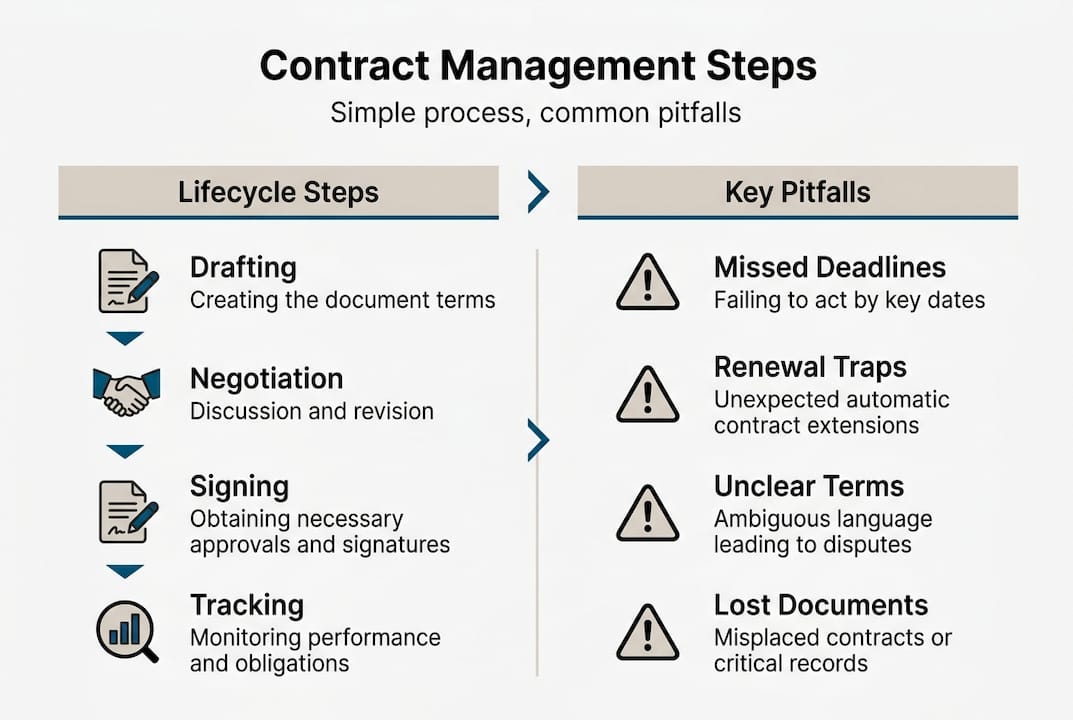
Every contract moves through a series of stages, and understanding each one helps you spot where value is created and where risk sneaks in. The key stages are:
Request/Initiation — Identifying the need for a contract and gathering the basic terms
Drafting/Authoring — Writing the actual agreement, often using templates
Negotiation — Back-and-forth adjustments between parties
Review/Approval — Internal sign-off before anything is finalized
Execution/Signing — Both parties formally agree, often via e-signature
Storage/Tracking — Saving the signed document in an accessible, secure location
Compliance/Performance Monitoring — Making sure both sides do what they agreed to
Renewal/Termination — Deciding whether to extend, renegotiate, or end the agreement
Most freelancers handle stages one through five reasonably well. It’s stages six through eight where things break down. A contract sitting in an email thread is not a contract management system.
The difference between manual and digital lifecycle management is significant:
Stage | Manual approach | Digital/CLM approach |
|---|---|---|
Drafting | Word doc, lots of back-and-forth | AI-generated templates, version control |
Signing | Print, scan, email | Built-in e-signature, instant delivery |
Storage | Email folders or local drives | Secure cloud vault, searchable |
Tracking | Spreadsheets or memory | Automated alerts and dashboards |
Renewal | Calendar reminders (if remembered) | Automated renewal notifications |
The contract lifecycle management tools available today eliminate most of the manual work. They track deadlines, flag upcoming renewals, and store everything in one place.

Pro Tip: Centralize all your contracts in one digital location the moment they’re signed. Even a simple folder system beats scattered emails, but a dedicated tool with search and alert features beats both.
Common contract pitfalls and how to avoid them
Knowing the steps is important, but mistakes can still happen. Let’s tackle the most common and preventable traps.
80% of businesses lack clear contract accountability, which creates real value gaps. For freelancers and small business owners, this often shows up in a handful of recurring mistakes:
Auto-renewal traps: Contracts that renew automatically with short notice windows (sometimes as little as 30 days) can lock you into another year of unfavorable terms before you even realize it
Liability caps that only protect one side: Many standard contracts cap the vendor’s liability at the contract value, leaving you exposed if their failure causes you bigger losses
IP grabs: Some client contracts claim ownership of everything you create during the engagement, including work that isn’t directly related to their project
Unilateral modification clauses: These let the other party change terms with minimal notice, which can shift pricing, scope, or obligations without your explicit agreement
Post-term data hostage risks: Vendors or platforms that hold your data after a contract ends, making it expensive or difficult to leave
“The clause you skim over during a busy week is the one that costs you six months later.”
The most common red flags include auto-renewal traps, liability caps, IP grabs, and unilateral modifications. The fix is to negotiate mutual terms and carve-outs wherever possible.
When you’re reviewing any contract, pay close attention to the renewal section, the modification process, and the indemnity language. These three areas cause the most disputes for small operators.
Pro Tip: Before signing, highlight every clause that mentions renewal, modification, or indemnity. If any of those clauses only protect the other party, push back. Most counterparties expect negotiation on these points.
Avoiding contract management mistakes isn’t about being paranoid. It’s about being prepared. A 15-minute review of key clauses before signing can save you from months of headaches.
Affordable contract management solutions for freelancers and small businesses
Even with strong awareness of risks, using the right tools makes contract management far easier and more effective.
The good news: you don’t need an enterprise system to manage contracts well. Affordable AI-powered tools like SignME, PandaDoc, Concord, and Altova start around $25 per user per month and cover most of what freelancers and small businesses actually need.
Here’s a comparison of common options:
Tool | Starting price | Key features |
|---|---|---|
LexFlow | Affordable tiers | AI drafting, e-signatures, clause explanations, vault storage |
PandaDoc | ~$35/user/mo | Templates, e-signatures, analytics |
Concord | ~$25/user/mo | Collaboration, version control, alerts |
Altova | ~$25/user/mo | Document management, compliance tracking |
78% of organizations invested in CLM (contract lifecycle management) technology over the past five years, and manual processes are increasingly recognized as error-prone and inefficient. For small operators, the switch to even a basic digital tool pays for itself quickly.
Here’s a simple checklist to start managing contracts more effectively right now:
Centralize storage: Move all active contracts to one location, digital and searchable
Set renewal alerts: Flag every contract’s renewal or expiration date with a 60-day advance notice
Use templates: Stop drafting from scratch; templates reduce errors and save time
Automate reminders: Use your tool’s notification features so nothing slips through
Review before signing: Always check renewal, modification, and indemnity clauses
Track obligations: Note what you owe and what others owe you in each contract
A contract automation tool removes the manual burden and lets you focus on the work that actually grows your business. The goal isn’t perfect legal knowledge. It’s a reliable system that catches problems before they become expensive.
The uncomfortable truth most freelancers and small businesses miss
Here’s the honest take: most freelancers and small business owners don’t avoid contract management because it’s hard. They avoid it because it feels like a future problem. “I’ll deal with it when something goes wrong” is the default setting.
But by the time something goes wrong, the leverage is gone. We’ve seen this pattern repeatedly. A freelancer misses a 30-day auto-renewal window and gets billed for another full year on a tool they stopped using. A small agency signs a client contract with an IP clause that quietly claims ownership of their internal processes. These aren’t edge cases. They’re routine.
The contrarian advice here is to start embarrassingly simple. You don’t need a sophisticated system on day one. A spreadsheet tracking your five active contracts with renewal dates and key obligations is infinitely better than nothing. Then layer in a digital tool when volume demands it.
Check out what actually works for small operators at different stages. The pattern is consistent: small, consistent habits beat occasional heroic reviews every time. Set automated reminders for every contract milestone and treat them like client deadlines. Because legally, they are.
Unlock easy contract management with LexFlow
If reading this made you realize your contract process has some gaps, you’re not alone, and the fix doesn’t have to be complicated.
LexFlow is built specifically for freelancers, founders, and small business owners who need professional contracts without the professional legal fees. You can create and sign contracts in minutes using AI-generated templates tailored to your jurisdiction, with plain-English explanations of every clause so you always know what you’re agreeing to. Built-in e-signatures, secure document storage, and automated tracking mean your contracts don’t just get signed. They get managed. Review the legal contract disclaimer to understand how LexFlow supports your agreements responsibly.
Frequently asked questions
What are the main steps in contract management?
Contract management includes initiation, drafting, negotiation, approval, execution, storage, compliance monitoring, and renewal or termination. Each stage carries distinct risks and opportunities for both parties.
How can freelancers manage contracts without legal expertise?
Freelancers can use affordable AI-powered tools and contract templates to streamline creation, tracking, and renewal alerts without needing a legal background. Plain-English clause explanations make it easy to understand what you’re signing.
What is the risk of ignoring contract management?
Poor contract management leads to up to 9.2% annual revenue loss, missed obligations, and legal exposure that can be difficult and costly to resolve.
Are expensive contract management systems necessary?
No. Freelancers and small businesses benefit most from simple, affordable solutions rather than costly enterprise systems designed for large legal teams with complex workflows.