What is a legal template? Guide for freelancers 2026

What is a legal template? Guide for freelancers 2026
Drafting a contract from scratch sounds like something only a lawyer should do. But here’s the reality: templates save 90% of the time it takes to draft legal documents manually, and well-structured contracts prevent roughly 90% of business disputes. For freelancers and small business owners, that’s not a minor convenience. The average small business dispute costs around $12,000 to resolve. Legal templates give you a real shot at protecting yourself without paying attorney rates every time you need a new agreement. This guide breaks down exactly what a legal template is, how to use one, where they shine, and where they fall short.
Table of Contents
Understanding legal templates: Definition and core purpose
How legal templates work: Step-by-step breakdown
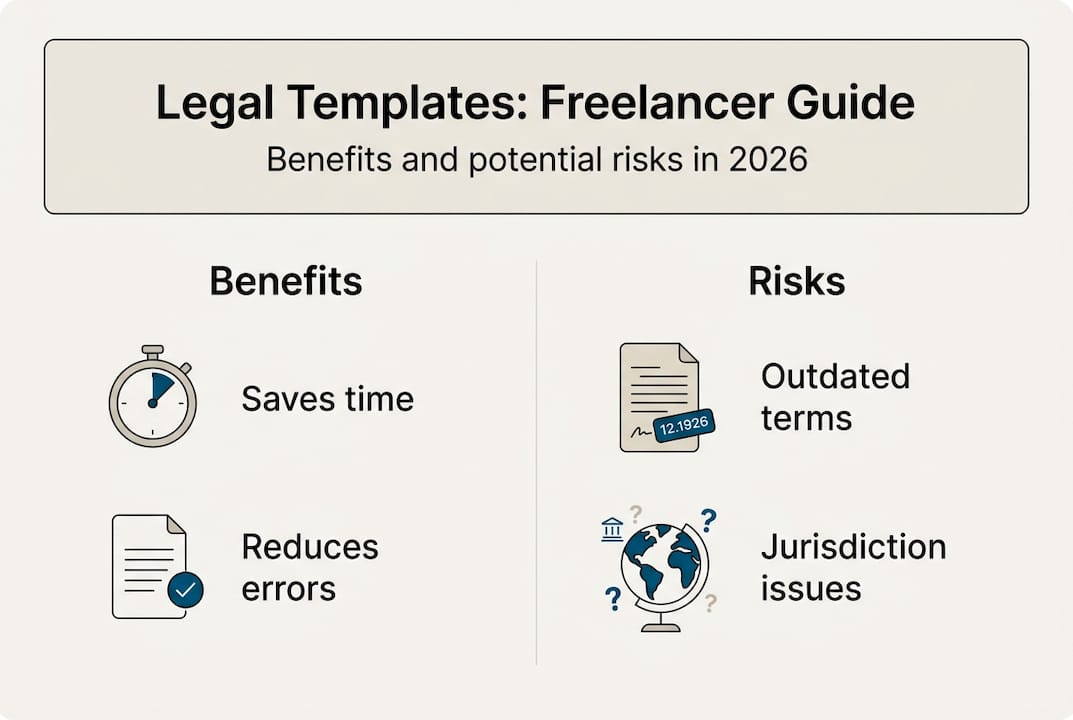
Benefits of legal templates for small businesses and freelancers
Risks and limitations: When templates fall short
Choosing and customizing legal templates effectively
Get started with reliable legal templates
Frequently asked questions
Key Takeaways
Point | Details |
|---|---|
Saves time and costs | Using legal templates can reduce contract preparation time by up to 90 percent, freeing up valuable business resources. |
Must be customized | Every template requires personalized information to ensure it is legally valid and fits your specific situation. |
Check for risks | Generic or outdated templates may lack enforceability or proper legal protection, especially in complex cases. |
Best for routine contracts | Templates are most effective for standard agreements in low-risk, high-frequency business transactions. |
Understanding legal templates: Definition and core purpose
So what exactly is a legal template? A legal template is a pre-drafted, standardized legal document with blanks or placeholders that you fill in with your specific details. Think of it like a form letter, but with legal weight behind it. You’re not writing the law from scratch. You’re applying an established structure to your situation.
Templates exist for almost every common business need:
Service agreements (for freelancers delivering work to clients)
Non-disclosure agreements (NDAs) (to protect confidential information)
Partnership contracts (to define roles and profit splits between co-founders)
Independent contractor agreements (to clarify the working relationship)
Simple wills and estate documents (for personal legal planning)
The core purpose is access. Before templates became widely available, small businesses either paid hundreds of dollars per contract or operated without any written agreement at all. Both options carry serious risk. Templates level the playing field by giving you a professionally structured document that you can adapt yourself.
“Legal templates don’t replace lawyers. They replace the blank page, which is often the most expensive part of the process.”
If you’ve ever wondered about the difference between manual vs template drafting, the short answer is speed, cost, and consistency. Templates win on all three for routine agreements.
How legal templates work: Step-by-step breakdown
Using a legal template is more straightforward than most people expect. The process involves filling placeholders with your specific information and reviewing the result carefully before signing. Here’s how it typically goes:
Identify the type of agreement you need. Are you hiring a subcontractor? Protecting a business idea? Formalizing a client relationship? Start by naming the agreement type.
Find a reputable template source. Use a trusted legal platform, a law firm’s published resources, or a contract automation tool. Avoid random Google docs with no clear origin.
Fill in every placeholder. Names, dates, payment terms, deliverables, deadlines. Every blank matters. Leaving one empty can make the whole document unenforceable.
Read the full document. Don’t just skim. Understand what each clause commits you to. If a section is confusing, look it up or flag it.
Get signatures from all parties. A contract without signatures is just a draft. Use e-signature tools to make this fast and legally valid.
Store the signed document safely. You’ll need it if a dispute ever comes up.
Pro Tip: For any deal worth more than a few thousand dollars, have a lawyer glance at your completed template before you send it. A one-hour review is far cheaper than a dispute.
Templates work across formats: Word documents, PDFs, and dedicated contract platforms. The format matters less than the content. What you fill in, and how carefully you review it, determines whether the document actually protects you. Always check the legal template risks before relying on any template for high-stakes situations.
Benefits of legal templates for small businesses and freelancers
The numbers tell a clear story. Here’s a quick look at what templates actually deliver:
Benefit | Without templates | With templates |
|---|---|---|
Time to draft a contract | 3 to 5 hours | 20 to 30 minutes |
Cost per agreement | $300 to $1,500 (attorney fees) | $0 to $50 |
Dispute prevention rate | Variable | Up to 90% with proper contracts |
Consistency across agreements | Low | High |

Beyond the numbers, templates give small businesses something harder to quantify: confidence. When you send a client a clean, professional service agreement, it signals that you take your work seriously. It sets expectations before the project starts, not after something goes wrong.
Key advantages for freelancers and small business owners:
Speed. You can generate a solid contract in under 30 minutes instead of spending hours writing from scratch.
Cost savings. Contract automation dramatically reduces or eliminates attorney drafting fees for routine agreements.
Dispute prevention. Clear written terms reduce misunderstandings. Most client conflicts come from vague or missing agreements, not bad intentions.
Consistency. Using the same template structure across clients means you’re not accidentally leaving out key clauses.
Research from legal benchmarks data confirms that businesses using structured contract processes resolve disputes faster and with lower costs than those relying on informal agreements. For a solo freelancer or a five-person team, that difference is significant.
Risks and limitations: When templates fall short
Templates are powerful, but they’re not magic. Here’s where things can go wrong.
Generic language that doesn’t fit your situation. A template written for a general service agreement may not cover the specific risks of your industry. A web developer’s contract has different needs than a photographer’s.
Outdated terms. Laws change. A template from three years ago may reference regulations that no longer apply, or miss new requirements entirely. Generic or outdated templates often fail when tested in court.
Jurisdictional mismatches. A contract template written for California may not be enforceable in Texas or New York. Local laws on payment terms, non-compete clauses, and liability caps vary widely.
Here’s a quick comparison to help you decide when a template is enough:
Situation | Template appropriate? | Attorney needed? |
|---|---|---|
Standard freelance service agreement | Yes | Optional review |
NDA for a routine partnership | Yes | Optional review |
High-value acquisition or merger | No | Yes |
Regulated industry contract (healthcare, finance) | No | Yes |
International agreement | No | Yes |
Red flag scenarios where templates are unsafe:
Deals worth $50,000 or more
Contracts involving intellectual property ownership
Agreements in regulated industries like healthcare or financial services
Any situation where complex deals require custom legal language
Pro Tip: Check the risks of free templates before using any document you found for free online. Free doesn’t always mean safe, and a missing clause can cost you far more than a proper template would have.
The honest truth is that free contracts often fail in disputes because they lack the specificity that courts look for. Use templates for routine work. Bring in a professional when the stakes are high.
Choosing and customizing legal templates effectively
Not all templates are created equal. Here’s how to pick the right one and make it work for your situation.
Define the agreement type first. Before searching for a template, write down in plain language what you need the contract to do. Who is involved? What is being exchanged? What happens if something goes wrong?
Use reputable sources. Look for templates from established legal platforms, bar associations, or trusted legal tech companies. Avoid templates with no author, no date, and no jurisdiction listed.
Personalize every field. Don’t treat placeholders as optional. Fill in every name, date, dollar amount, and deadline. A contract with “[CLIENT NAME]” still in it is not a contract.
Check for jurisdiction-specific language. Make sure the template references the correct state or country laws. Some platforms let you select your location and auto-adjust the language.
Review the key clauses. Pay special attention to payment terms, termination rights, liability limits, and dispute resolution methods. These are the sections that matter most when things go sideways.
For choosing legal templates, the best practice is to treat the template as a starting point, not a finished product. Customization is what turns a generic document into a real agreement.
Pro Tip: Templates are ideal for routine contracts, but attorney review adds enforceability for anything above routine. Even a 30-minute consultation can catch gaps you’d never notice on your own.
Once you’ve customized your template, read it out loud. If a sentence doesn’t make sense to you, it probably won’t make sense to a judge either. Clarity is a feature, not a formality.
Get started with reliable legal templates
You now have a solid understanding of what legal templates are, how they work, and where to use them carefully. The next step is putting that knowledge into action with tools built specifically for freelancers and small business owners.
LexFlow gives you access to professional legal templates designed for the agreements you actually need, from service contracts to NDAs to partnership agreements. Every template is built with plain-English explanations so you understand what you’re signing, not just what you’re filling in. You can generate, customize, e-sign, and store your contracts in one place, without needing a law degree or a legal budget. And if you want to understand the boundaries of what templates can do, the compliance guidance section walks you through exactly when to seek additional legal support. Start protected, stay protected.
Frequently asked questions
Are legal templates enforceable in court?
Legal templates can be enforceable when properly customized and compliant with local law, but generic or outdated terms often fail to hold up in disputes. Always personalize every field and verify that the template applies to your jurisdiction.
When should I avoid using a legal template?
Avoid templates for complex, high-value, or regulated transactions where jurisdictional compliance is uncertain. These edge cases require attorney drafting to ensure the contract is enforceable and complete.
What are the most common mistakes when using legal templates?
Leaving placeholders unfilled, ignoring local law differences, and using outdated documents are the top errors. Non-compliance and missing clauses are the most common reasons template-based contracts fail.
Can I use a free template for client contracts?
Free templates work well as a starting point for standard agreements, but always check for missing clauses. For important transactions, routine contracts need careful customization and ideally a legal review before you rely on them.