Why legally binding signatures matter for freelancers

Why legally binding signatures matter for freelancers
TL;DR:
Legally binding signatures show clear intent and agreement to contract terms, whether handwritten or electronic.
Electronic signatures are valid and offer faster, cost-effective, and traceable alternatives to handwritten signatures.
Some documents like wills or court orders cannot be signed electronically; understanding exceptions is crucial.
You finish a project, send the invoice, and hear nothing back. The client claims they never agreed to those terms. You remember the conversation clearly, but without a signed contract, you have almost nothing to stand on. This scenario plays out constantly for freelancers and small business owners who treat signatures as a formality rather than a legal tool. Understanding what makes a signature legally binding is not just about protecting yourself in court. It is about building business relationships that run smoothly, pay on time, and create less stress from day one.
Table of Contents
Understanding legally binding signatures: What does it really mean?
Electronic vs. handwritten signatures: How do they compare?
Exceptions: When signatures may not be legally binding
Practical steps to make your signatures legally binding
The overlooked value of signatures in simplifying business relationships
Ready to simplify your contracts? Try LexFlow today
Frequently asked questions
Key Takeaways
Point | Details |
|---|---|
Signatures show intent | A signature—written or digital—proves parties agree to a contract’s terms. |
E-signatures save time | Electronic signatures streamline agreement processes for freelancers and small businesses. |
Check for exclusions | Certain legal documents like wills or court orders cannot use electronic signatures. |
Clarity prevents disputes | Clear contract language and strong documentation help enforce your agreements. |
Understanding legally binding signatures: What does it really mean?
A legally binding signature is not just a scribble at the bottom of a page. It is a formal signal that you understand and agree to the terms of a contract. When both parties sign, they are telling the law: “We both read this, we both agree, and we both accept the consequences if we don’t follow through.”
Both handwritten and electronic signatures can carry the same legal weight. The key is that the signature must reflect intent. You cannot accidentally sign a binding contract. There must be a clear, voluntary act that demonstrates you are entering into an agreement.
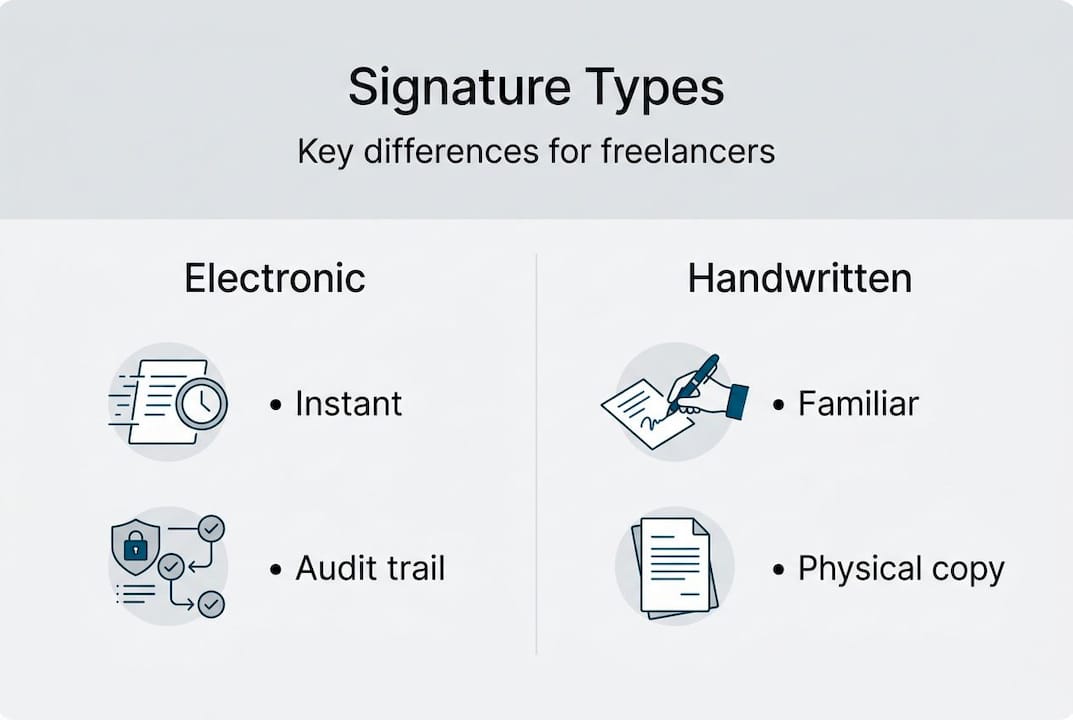
Federal law backs this up. E-signatures are recognized under federal law for most business agreements through the Electronic Signatures in Global and National Commerce Act (ESIGN Act), passed in 2000. Most states also follow the Uniform Electronic Transactions Act (UETA), which aligns closely with ESIGN. Together, these laws make digital signatures just as enforceable as pen-and-paper ones for the vast majority of commercial contracts.
Here is what a legally binding signature typically confirms:
Intent: The signer willingly agrees to the contract terms
Consent: The signer was not coerced or misled
Identity: The signature can be traced back to a specific person
Record: A copy of the signed document is retained by both parties
That said, not every document qualifies. Some contract exclusions exist where e-signatures are not accepted, including wills, adoptions, and certain court orders. For most freelancer agreements, service contracts, and business deals, however, a valid signature is all you need to make the agreement enforceable.
“A signature is not just a name. It is a legal statement that you have read, understood, and agreed to be bound by the terms of a contract.”
The practical takeaway here is simple. Every time you sign or ask someone else to sign, you are creating a legal record. That record protects you if anything goes wrong later.
Electronic vs. handwritten signatures: How do they compare?
Now that you understand what makes a signature binding, it is important to see how electronic signatures stack up against traditional ones.
Handwritten signatures have been the standard for centuries. They feel official, they are familiar, and in some cases they are still required. But for most day-to-day freelance and small business contracts, they are slow, inconvenient, and harder to track.

Electronic signatures solve most of those problems. You can send a contract, get it signed, and have a copy stored in seconds, regardless of where your client is located. Speed matters when you are running a business. Waiting three days for a signed PDF to come back in the mail is not a realistic workflow in 2026.
Here is a direct comparison:
Feature | Electronic signature | Handwritten signature |
|---|---|---|
Speed | Instant | Days or weeks |
Audit trail | Automatic and detailed | Manual, often incomplete |
Remote use | Yes | Requires in-person or mail |
Legal validity | Valid for most contracts | Valid for all contracts |
Cost | Low to free | Paper, printing, postage |
Storage | Digital, searchable | Physical, easy to lose |
The audit trail point is worth emphasizing. When you use a digital platform, every action is time-stamped. You can see exactly when a document was opened, reviewed, and signed. That level of detail is nearly impossible to replicate with a pen-and-paper process.
For freelancers specifically, the shift toward written contracts is becoming a legal requirement in some states. California’s Freelance Worker Protection Act now requires written contracts for independent contractors in many situations, reflecting a broader recognition that verbal agreements leave workers unprotected. Using e-signature platforms makes compliance with these rules much easier.
Pro Tip: If you work with clients across multiple states, e-signatures dramatically reduce the friction of getting contracts finalized quickly. A faster signature means a faster project start and a faster payment.
Handwritten signatures still have their place. For notarized documents, real estate closings, or documents requiring a witness, you may still need ink on paper. But for the everyday service agreements, project contracts, and NDAs that freelancers and small business owners rely on, electronic signatures are faster, cheaper, and equally valid.
Exceptions: When signatures may not be legally binding
Despite their power, not every document or situation qualifies for legally binding signatures.
The most important thing to understand is that a signature alone does not make a contract enforceable. The underlying agreement must also be valid. If someone signs under duress, without understanding what they are signing, or if the contract itself is for something illegal, the signature means nothing.
Beyond that, federal law specifically excludes certain documents from e-signature validity, including:
Wills and testamentary trusts
Family law matters like adoption and divorce
Court orders and official court documents
Notices of foreclosure, eviction, or utility termination
Certain sections of the Uniform Commercial Code (UCC) covering negotiable instruments
These exclusions exist because the stakes are high and the risk of fraud or confusion is greater. For these documents, you need traditional signatures, often with witnesses or notarization.
There are also edge cases that catch people off guard. Consumer consent is not optional. If you are sending a contract to a consumer (not a business), you must give them a clear opportunity to consent to receiving and signing documents electronically. Burying that consent in fine print does not count.
“Ensure clear intent is present and not buried in fine print. Consumer consent is required before electronic signatures can be used in consumer-facing agreements.”
State-level variations add another layer of complexity. New York, for example, operates under its own Electronic Signatures and Records Act (ESRA) rather than UETA. The rules are similar, but the differences matter. If you are working across state lines, it is worth reviewing the electronic signature validity rules for each relevant state. Reviewing excluded contracts before you finalize any agreement is a smart habit to build.
The bottom line: a signature is only as strong as the process behind it. Get the consent, use the right format, and make sure the document itself is legally sound.
Practical steps to make your signatures legally binding
With knowledge of exceptions, let’s focus on the steps you can take to ensure every signature counts.
Making your signatures legally binding is not complicated, but it does require intentional steps. Here is a clear process to follow:
Choose the right platform. Use a tool that provides time-stamped audit trails, identity verification, and secure document storage. These features are what turn a simple signature into a legally defensible record.
Express clear consent before signing. Both parties should explicitly agree to use electronic signatures. Do not assume consent. A simple checkbox or confirmation step is enough.
Match the contract format to the document type. Service agreements, NDAs, and project contracts are all fine for e-signatures. Wills and court filings are not.
Store every signed agreement securely. A signature you cannot produce in a dispute is almost worthless. Use a platform with a secure document vault.
Review state-specific requirements. If you work across jurisdictions, confirm that your process meets the rules in each state where your clients are located.
Pro Tip: Before finalizing any contract, check whether your client is in a state with unique e-signature rules. A quick review now can save a major headache later.
Here is a quick reference for common contract types and their signature requirements:
Contract type | E-signature valid? | Notes |
|---|---|---|
Freelance service agreement | Yes | Standard for most states |
NDA | Yes | Widely accepted |
Employment contract | Yes | Check state rules |
Real estate lease | Usually yes | Some states require wet ink |
Will or trust | No | Requires handwritten signature |
Court filing | No | Must follow court rules |
Consumer consent and proper documentation are critical for validity, especially when signing with individuals rather than other businesses. Using digital contract tools that handle these requirements automatically removes the guesswork entirely.
The overlooked value of signatures in simplifying business relationships
Most articles about legally binding signatures focus entirely on what happens when things go wrong. The lawsuit. The dispute. The unpaid invoice. That framing is understandable, but it misses something important.
Signatures do more than protect you legally. They create clarity. When both parties sign a contract, they are forced to read the same document, agree on the same terms, and acknowledge the same expectations. That shared understanding is what prevents most disputes before they ever start.
In our experience working with freelancers and small business owners, the biggest source of conflict is not bad intent. It is misunderstanding. Someone assumed the project included revisions. Someone else thought payment was due on delivery. A signed contract eliminates those assumptions.
The real lesson here is that formalization is not about distrust. It is about respect. Asking a client to sign a contract says: “I take this relationship seriously, and I want us both to be clear on what we’re agreeing to.” Most professional clients will appreciate that, not resent it.
Using contract management simplicity tools makes it easy to build this habit without slowing down your workflow. When signing takes seconds, there is no excuse to skip it.
Pro Tip: Treat every signed contract as a conversation starter, not a legal weapon. Walk your client through the key terms before they sign. It builds trust and prevents confusion.
Ready to simplify your contracts? Try LexFlow today
Understanding legally binding signatures is the first step. Putting that knowledge into practice is where most freelancers and small business owners get stuck.
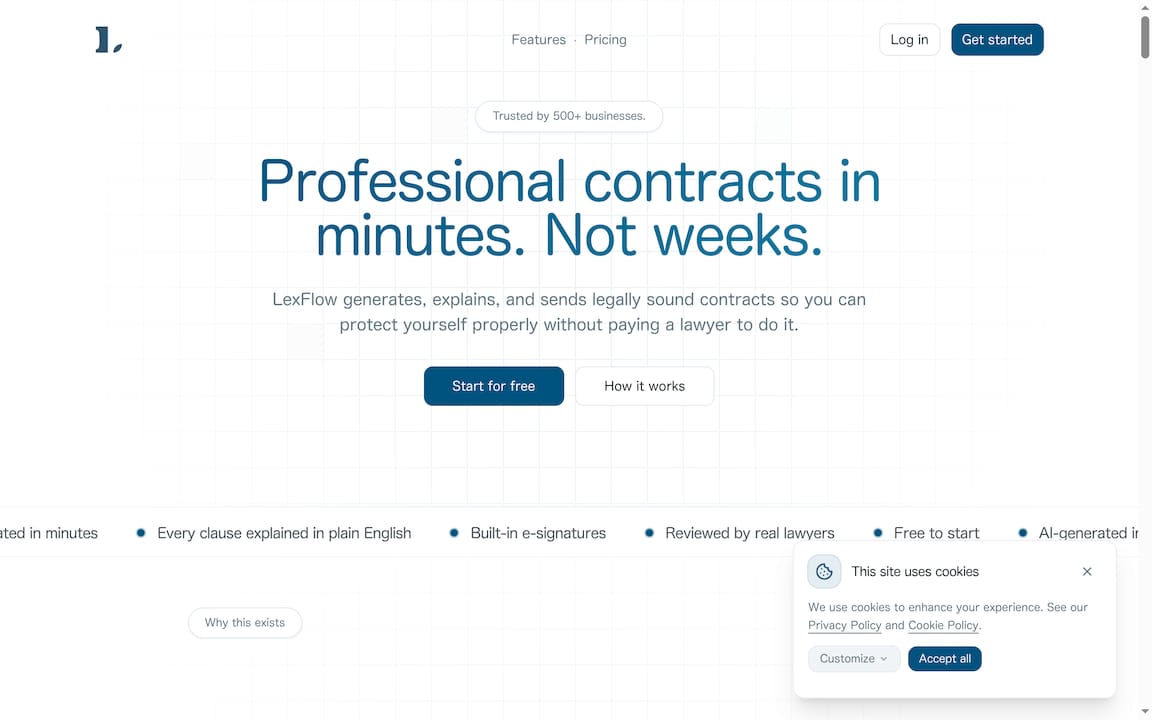
LexFlow makes it easy to create and sign contracts in minutes, with no legal background required. The platform generates contracts tailored to your situation, explains every clause in plain English, and handles e-signatures and secure storage automatically. No confusing jargon, no expensive attorney fees, and no chasing clients for paperwork. You can review contract compliance details directly on the platform to make sure every agreement meets the right legal standards. Whether you are a solo freelancer or running a growing small business, LexFlow gives you the tools to protect yourself without slowing you down.
Frequently asked questions
What makes a signature legally binding?
A signature is legally binding if it shows clear intent and is attached to a valid agreement under relevant law. Federal e-signature law recognizes both electronic and handwritten signatures for most business contracts.
Can freelancers use electronic signatures for all contracts?
Most freelancer contracts can use electronic signatures, and some states now require written contracts for independent contractors. Exceptions include wills, family court documents, and certain court filings.
Are electronic signatures valid in every US state?
Most states accept e-signatures when legal requirements are met, but some states like New York have unique state rules under their own electronic signature laws rather than UETA.
What are the most common mistakes when using e-signatures?
Missing clear consumer consent and using e-signatures for excluded documents are the biggest pitfalls. Clear intent and consent must be explicit, not buried in fine print.