Why review contracts: prevent legal risks in 2026

Why review contracts: prevent legal risks in 2026
Most freelancers and small business owners treat contracts like terms of service agreements: they scroll to the bottom and sign. That instinct is expensive. 70% of freelance contracts contain excessive risk-shifting clauses, and nearly three-quarters of freelancers lack the legal training to spot them. The result? Disputes, unpaid invoices, personal liability, and lost opportunities that could have been avoided with a focused review. This guide walks you through exactly why contract review matters, what to look for, how real businesses have been burned, and which tools actually help you stay protected.
Table of Contents
Contracts: Your business’s hidden risk zone
What does a contract review really check for?
Missed pitfalls: Real-world stories and costly edge cases
Manual vs. AI-powered review: Which actually works?
What most founders and freelancers get wrong about contract review
Take control of your contracts with LexFlow
Frequently asked questions
Key Takeaways
Point | Details |
|---|---|
Missed contract risks | Contracts are full of pitfalls that can cost your business money, control, or reputation if left unchecked. |
Structured review matters | Using detailed checklists and clear red-flag spotting transforms risky documents into strong business tools. |
Hybrid review wins | Combining AI efficiency with human judgment produces the safest, most cost-effective contract reviews today. |
Review enables leverage | Proper reviews don’t just prevent losses—they let you negotiate and grow with confidence. |
Contracts: Your business’s hidden risk zone
Contracts feel routine until they’re not. A client sends over a standard services agreement, you skim it, sign it, and move on. Weeks later, a scope dispute erupts. Or you finish a project and discover a clause that lets the client delay payment indefinitely. These aren’t rare horror stories. They’re the predictable result of treating legal documents as formalities.
The financial stakes are real. Businesses lose 8-9% of annual revenue due to contract mismanagement. For a freelancer billing $80,000 a year, that’s roughly $6,400 walking out the door. For a startup with $500,000 in contracts, it’s $40,000 or more. These losses don’t always show up as dramatic lawsuits. Most bleed out quietly through vague payment terms, uncapped liability, and auto-renewing agreements nobody noticed.
Here’s a snapshot of where contract risk typically hides:
Risk area | Common clause type | Potential impact |
|---|---|---|
Payment terms | Net-90 or undefined schedules | Cash flow disruption |
Scope of work | Broad or undefined deliverables | Scope creep, unpaid work |
Liability | Uncapped or unlimited exposure | Personal financial ruin |
IP ownership | Work-for-hire with broad assignment | Loss of portfolio rights |
Auto-renewal | Silent renewal with penalty clauses | Locked into unwanted terms |
Some of the most dangerous clauses are buried in plain language. A line that reads “contractor is responsible for all consequential damages” can mean you’re personally on the hook for a client’s lost profits if a project runs late. That’s not a technicality. That’s contract liability risk that can exceed the value of the contract itself.
Common contract mistakes freelancers and startups make include:
Accepting unlimited liability without negotiating a cap
Signing agreements with no defined payment schedule
Overlooking intellectual property assignment clauses
Missing termination notice requirements
Ignoring jurisdiction and governing law provisions
“Most contract problems aren’t caused by bad actors. They’re caused by busy people who didn’t read carefully enough.”
The good news is that most of these risks are visible if you know where to look. The next step is building a process that makes looking automatic.
What does a contract review really check for?
To avoid those risks, you need a laser-focused approach when you review any contract. A contract review isn’t just reading. It’s a structured analysis that checks specific categories in a specific order.
A solid contract review process moves through these stages:
Intake — Identify the parties, the governing law, and the contract type before reading anything else.
Commercial terms analysis — Verify payment amounts, schedules, milestones, and penalties.
Risk and liability review — Flag indemnity clauses, liability caps, and warranty obligations.
Duration and renewal check — Confirm start dates, end dates, auto-renewal triggers, and notice periods.
IP and compliance review — Clarify ownership of deliverables, licensing rights, and any regulatory requirements.
Negotiation and sign-off — Identify what’s negotiable, propose redlines, and confirm final terms before executing.
A thorough review checklist covers parties, commercial terms, risk and liability, duration, compliance, and IP. Skipping even one category creates a blind spot.
Here’s how a basic versus thorough review compares:
Review type | What gets checked | Risk level |
|---|---|---|
Basic skim | Parties, price, dates | High |
Standard review | Above plus payment terms, IP | Medium |
Thorough review | All six categories above | Low |
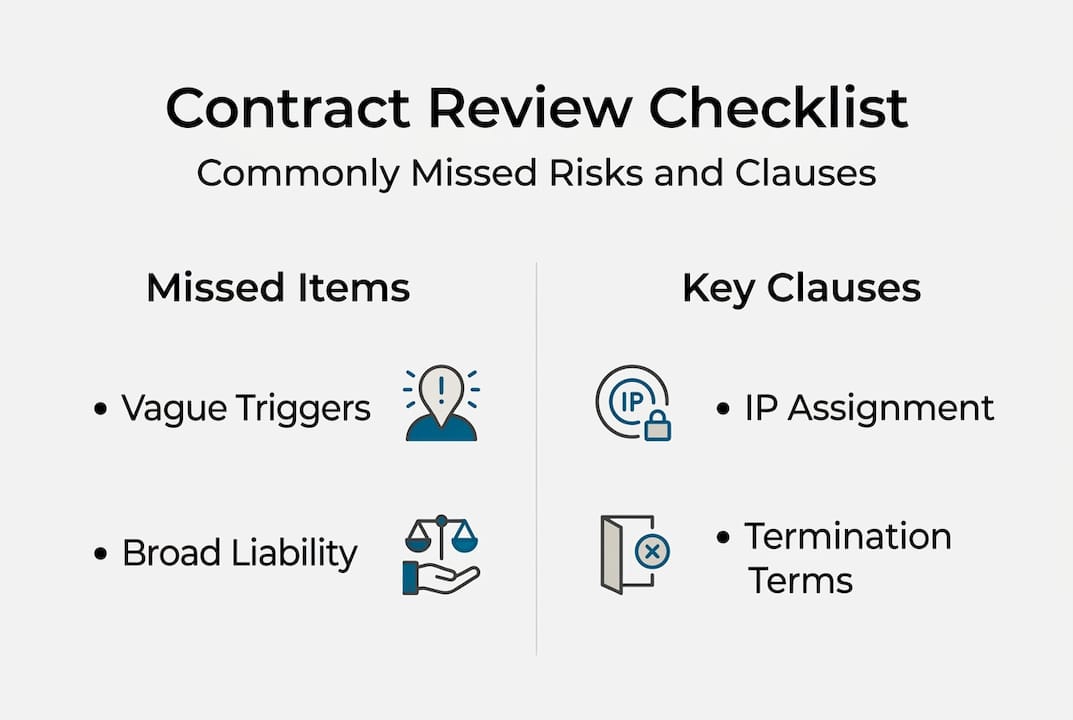
Items most commonly missed in quick reviews include vague payment triggers (“upon client satisfaction”), broad IP assignments that cover future work, non-compete clauses buried in service agreements, and automatic renewal windows as short as 15 days.
Pro Tip: Read every contract backward. Start from the definitions section and termination clauses before reading the main obligations. The most dangerous language is usually at the back.
The goal isn’t to become a lawyer. It’s to know enough to ask the right questions and recognize when something needs a closer look before you sign.
Missed pitfalls: Real-world stories and costly edge cases
But what gets missed in real-world contracts and what can it cost? Here are critical lessons drawn from actual business situations.
One founder discovered a $50,000 liability clause buried in a vendor agreement. The clause held the startup responsible for the vendor’s operational losses if the integration failed. AI caught 68% of errors that human reviewers had missed during the initial pass. The founder only found the clause because a second review flagged unusual indemnity language. Without that second pass, the company would have signed away its financial stability.

Freelancers face equally sharp edges. A graphic designer signed a services agreement with a “work made for hire” clause that assigned ownership of all future designs created during the contract period, not just the project in question. The client later claimed ownership of work the designer had created for other clients during that window. The legal dispute cost more than the original contract was worth.
Common edge cases that destroy value:
Unlimited liability clauses — No cap on damages means your entire business is collateral.
Broad indemnity language — You agree to cover the client’s legal costs for claims you didn’t cause.
Auto-renew traps — Contracts that renew for 12-month terms unless you cancel within a 10-day window.
Exclusivity without compensation — You’re locked out of working with competitors but receive no premium for it.
Vague acceptance criteria — The client can reject deliverables indefinitely without triggering payment.
“The clause that costs you the most is usually the one you didn’t think applied to you.”
Pro Tip: Any clause that uses the words “sole discretion” or “reasonable satisfaction” without a defined standard is a red flag. Push for objective criteria every time.
The pattern across these stories is consistent. Danger doesn’t announce itself. It hides in legal risk exposure that looks routine until it isn’t. Catching it requires both a checklist and the habit of asking “what’s the worst this clause could mean?”
Manual vs. AI-powered review: Which actually works?
Having seen what can go wrong, the next decision is how to review your contracts: people, tech, or both?
Manual review by an attorney is thorough but expensive. Manual review costs between $470 and $2,000 per contract. For a freelancer signing four to six contracts a month, that’s potentially $12,000 a year just in legal fees. Most small businesses simply don’t budget for that, which means contracts go unreviewed or get a quick skim instead.
AI-powered review changes the math significantly. AI tools reduce review time by 75-80% and catch 99.6% of common contractual mistakes. Speed matters when a client sends a contract and expects a signature by end of day.
Here’s how the two approaches stack up:
Factor | Manual review | AI-powered review |
|---|---|---|
Cost per contract | $470 to $2,000 | $0 to $50 |
Average review time | 2 to 5 hours | 5 to 20 minutes |
Error detection rate | Variable | Up to 99.6% |
Context and nuance | Strong | Limited |
Negotiation guidance | Strong | Moderate |
AI tools excel at pattern recognition. They catch non-standard clauses, flag missing provisions, and compare language against legal benchmarks faster than any human. But they have real limits. AI doesn’t know your business relationship, your negotiating leverage, or the industry norms in your specific market. It can tell you a clause is unusual. It can’t tell you whether to walk away.
The most reliable approach for freelancers and small businesses is a hybrid model:
Use AI contract review tools to run the first pass and flag issues automatically.
Review flagged items yourself using the checklist from the previous section.
Consult a lawyer only for high-value contracts or genuinely complex clauses.
Pro Tip: Treat AI review as your first line of defense, not your last. It catches what you’d miss at 11pm before a deadline. Your judgment handles the rest.
This hybrid approach gives you speed, affordability, and the human judgment that context requires.
What most founders and freelancers get wrong about contract review
Here’s the uncomfortable truth: most people treat contract review as damage control. Something you do after a bad experience. That framing keeps you reactive.
The real value of consistent contract review is leverage. When you understand every clause before you sign, you negotiate from a position of knowledge. You push back on unfair terms. You ask for payment protections. You walk away from agreements that don’t serve you. That’s not legal caution. That’s business strategy.
We’ve seen founders over-rely on contract management best practices like templates and AI tools without actually reading the output. A template built for a SaaS company doesn’t automatically protect a solo consultant. AI flags issues but doesn’t understand your specific risk tolerance.
The freelancers and founders who build real protection treat every contract review as a learning opportunity. Each agreement teaches you something about how clients think, where risks concentrate, and what terms are actually negotiable. Over time, that knowledge compounds. You stop being surprised. You start being prepared.
Contract review isn’t a legal chore. It’s one of the highest-leverage habits you can build as a business owner.
Take control of your contracts with LexFlow
Understanding contract risk is the first step. Having the right tools to act on that knowledge is what actually protects your business.
LexFlow is built specifically for freelancers, startups, and small businesses who need professional-grade contracts without the professional-grade legal bills. You can create and review contracts using AI-powered tools that flag risky clauses, explain every provision in plain English, and guide you through the full process from draft to signed. Explore the LexFlow roadmap to see what’s coming, or get started immediately with ready-to-use SaaS terms templates designed for real business relationships. Stop signing blind.
Frequently asked questions
What are the biggest risks of not reviewing contracts?
Missed red flags can lead to lawsuits, unexpected liabilities, lost revenue, and personal financial exposure. 64% of US lawsuits are contract disputes, and businesses lose over 8% of annual revenue to poor contract management.
How much can poor contract management cost a small business?
Small businesses typically lose 9.2% of annual revenue from poor contract management, mostly through inefficiencies, overlooked terms, and disputes that could have been caught at the review stage.
Is AI contract review better than manual review?
AI is faster and catches up to 99.6% of common mistakes while cutting review time by 80%, but hybrid AI-human review is the safest approach since context and negotiation judgment still require a human.
What should I check first when reviewing a contract?
Start with the parties, scope of work, payment terms, liability and indemnity clauses, intellectual property rights, and exit provisions. A standard review checklist covers all six categories before you consider signing.