Why startups need legal protection: safeguard growth

Why startups need legal protection: safeguard growth
TL;DR:
Legal disputes over equity and roles cause up to 65% of startup failures.
Proper legal documentation and protection are affordable and essential at any stage.
Early legal safeguards improve funding prospects, build trust, and prevent costly disputes.
Most founders assume legal trouble is something that happens to other companies. The reality is that founder disputes over equity vesting and roles cause between 13% and 65% of startup failures, depending on the study. That is not a fringe risk. It is one of the most predictable ways a promising company falls apart before it ever reaches product-market fit. Legal protection is not a luxury reserved for companies with in-house counsel and deep pockets. It is a foundational tool that any startup, at any stage, can and should use to protect what they are building.
Table of Contents
The hidden costs of skipping legal protection
Key legal safeguards every startup needs
Navigating compliance and regulation: Don’t get caught off guard
How legal protection powers growth: Funding, deals, and trust
The uncomfortable truth most founders underestimate
Next steps: Affordable protection for your startup
Frequently asked questions
Key Takeaways
Point | Details |
|---|---|
Prevention beats cure | Startups save money and avoid failure by addressing legal risks early with basic documents. |
Growth needs protection | Patents, clear contracts, and compliance help startups unlock funding, deals, and partnership trust. |
Compliance is mandatory | Missing out on regulatory standards can block deals and expose founders to costly liability. |
Affordable solutions exist | Founders can use modern tools to manage legal protection without high legal costs. |
The hidden costs of skipping legal protection
Skipping legal safeguards feels like a smart move when you are watching every dollar. The problem is that the costs you avoid upfront tend to multiply later. A handshake deal with a co-founder, a verbal agreement with a contractor, or a copy-pasted privacy policy from another website can each become a serious liability the moment something goes wrong.
Here are the most common risks startups face when they skip proper legal documentation:
Founder disputes over equity and roles, which cause 13-65% of failures and often result in costly litigation or company dissolution
Contractor IP issues, where a developer or designer retains ownership of code or creative work because no assignment agreement was signed
Unexpected dilution from post-money SAFEs, where founders discover too late how much equity they gave away
Personal liability exposure when business and personal finances are not properly separated
Loss of trade secrets when employees leave without a signed NDA or non-compete clause
Consider a scenario many early-stage founders face: two co-founders split equity 50/50 with no vesting schedule. One leaves after six months. Without a formal vesting cliff in place, that departing founder walks away with half the company and zero ongoing contribution. Investors will not touch a cap table like that.
“The most expensive legal mistake is the one you did not think you needed to prevent.” This is the quiet consensus among startup attorneys who see the same avoidable disasters repeat across industries.
A comparison of outcomes with and without basic legal protection makes the stakes clear:
Scenario | Without legal docs | With legal docs |
|---|---|---|
Co-founder leaves early | Equity dispute, potential dissolution | Vesting cliff reclaims unvested shares |
Contractor builds core feature | IP ownership unclear | IP assignment secures company ownership |
Customer data breach | Regulatory fines, no liability shield | Privacy policy limits exposure |
Investor due diligence | Deal falls through | Clean cap table, faster close |
Pro Tip: Even a one-page formal legal agreement between co-founders, signed before you write a single line of code, can prevent the single most common cause of early startup failure.
Key legal safeguards every startup needs
Now that the risks are visible, the question becomes: which legal documents actually matter? The good news is that you do not need a 200-page legal binder to be protected. A focused set of documents covers most of the vulnerabilities early-stage startups face.
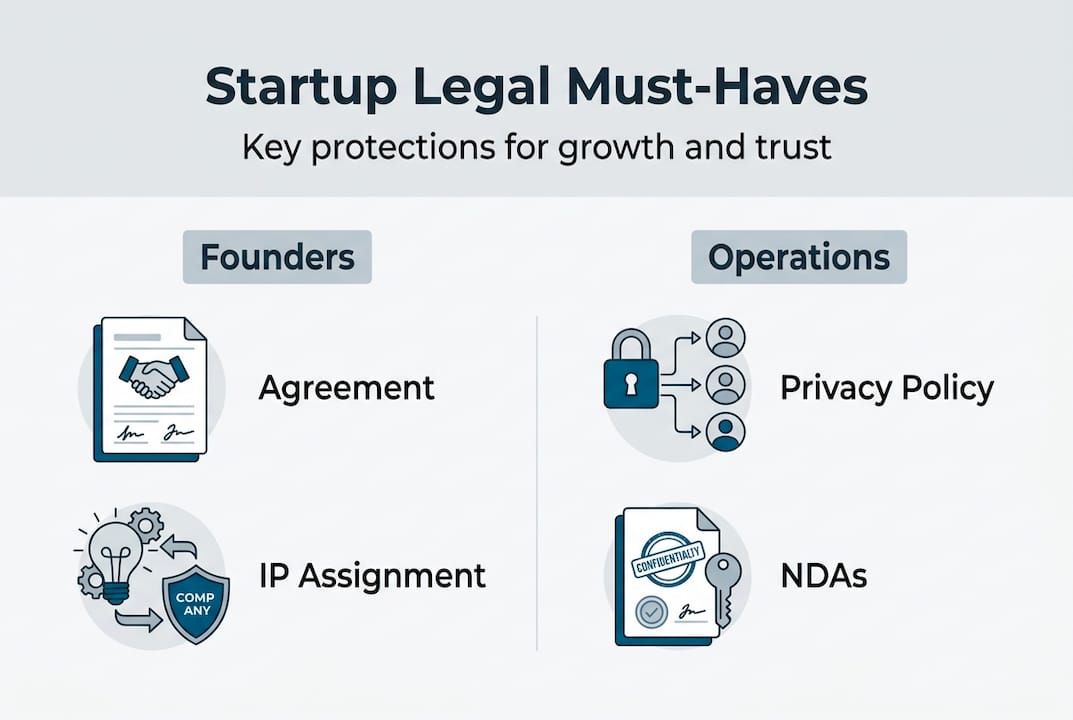
Founders’ agreement with equity vesting schedules and role definitions
Employment and contractor agreements with IP assignment clauses built in
Non-disclosure agreements (NDAs) for conversations with potential partners, investors, and hires
Terms of service and a privacy policy template that comply with applicable data laws
Intellectual property assignment agreements that transfer all work product to the company
Beyond documents, patents and trademarks deserve early attention. Early patent filing correlates positively with total funding raised and acquisition likelihood. Filing early, even provisionally, establishes a priority date that can be critical in competitive markets.
Compliance is another layer that founders often treat as an afterthought. GDPR applies if you have any users in the European Union. CCPA applies if you collect data from California residents. Labor classification rules determine whether your contractors are truly contractors or employees in the eyes of the IRS and state agencies.
Cross-border data flows are a particularly sharp edge. A startup that builds its user base internationally without addressing GDPR from the start faces an expensive retrofit later, often during a funding round when the timing could not be worse.
Pro Tip: Use a contract management platform to store, track, and update your legal documents as your team and product evolve. Static documents filed away in a folder do not protect you if they are never reviewed or updated.
Navigating compliance and regulation: Don’t get caught off guard
Compliance is the part of legal protection that most founders put off until it becomes urgent. The data makes a strong case for acting sooner. Regulatory and legal challenges contribute to 8% to 18% of startup failures, and enterprise customers increasingly expect compliance documentation before signing any contract.
Here is what non-compliance actually looks like in practice:
A SaaS startup lands its first enterprise client, then loses the deal because it cannot produce a GDPR-compliant data processing agreement
A two-person team classifies all workers as contractors to save on payroll taxes, then faces back taxes and penalties when an audit determines one worker was actually an employee
A founder collects email addresses for a waitlist without a proper privacy policy and receives a cease-and-desist from a state attorney general
The major regulatory frameworks every startup should understand in 2026:
Regulation | Who it applies to | Key requirement |
|---|---|---|
GDPR | Any startup with EU users | Data processing agreements, consent, right to erasure |
CCPA | Startups with California users | Privacy disclosures, opt-out rights |
FLSA/IRS contractor rules | US startups using contractors | Correct worker classification |
COPPA | Apps targeting children under 13 | Parental consent for data collection |
Practical steps to get compliant without a legal team: first, register your business entity properly so personal liability is separated from company liability. Second, conduct a data audit to understand what information you collect and where it goes. Third, document everything, including how you handle user data, how you classify workers, and how you store contracts. A well-maintained privacy policy for compliance is not just a legal checkbox. It signals to enterprise buyers that you are a serious operator.
Pro Tip: Set a calendar reminder to review your compliance documents every six months. Regulations change, your product changes, and your user base changes. A policy that was accurate at launch may be dangerously outdated 18 months later.
How legal protection powers growth: Funding, deals, and trust
Legal protection is often framed as purely defensive. That framing misses half the picture. Strong legal infrastructure is one of the most underrated growth tools available to early-stage companies.
Consider what happens during a funding round. Investors conduct due diligence on your cap table, your IP ownership, your contracts, and your compliance status. A clean legal foundation speeds up that process and increases your negotiating leverage. A messy one creates doubt, delays, and sometimes kills deals entirely.
The evidence on patents is particularly striking. Early patent filing is linked to higher total funding raised across technology startups, with the correlation strongest for companies that file before their first institutional round. Patents signal defensibility, which is exactly what investors want to see.
Beyond funding, legal documentation builds trust with customers and partners:
Enterprise clients require data processing agreements, liability caps, and indemnification clauses before signing
Distribution partners want clear IP ownership and licensing terms before co-marketing
Acquirers look for clean contractor agreements, assigned IP, and no pending litigation
Key hires feel more confident joining a company with proper employment agreements and equity documentation
According to startup failure rates, legal and regulatory issues are a top-ten cause of startup death. Flipping that statistic around, startups that invest in legal infrastructure early remove one of the most common failure modes from their risk profile.
Legal readiness is not just about avoiding problems. It is about being ready to say yes when the right opportunity shows up.
Pro Tip: Treat your first legal investment the same way you treat your first marketing spend. It is not overhead. It is infrastructure that makes every subsequent deal faster, cleaner, and more credible.
The uncomfortable truth most founders underestimate
Here is what we see repeatedly: founders who move fast and treat legal as something to fix later are not being lean. They are borrowing against their future. The legal mistakes that kill deals, contractor IP retention, unexpected SAFE dilution, worker misclassification, and GDPR retrofits are almost never surprises to the attorneys who clean them up. They are entirely predictable.

The myth is that legal rigor slows you down. The reality is that a 30-minute contract setup today prevents a 30-day legal dispute later. Affordable tools have eliminated the old excuse that legal protection requires a $500-per-hour attorney. You can protect your startup’s legal foundation with templates and AI-generated contracts that take minutes, not weeks.
Put legal on your MVP checklist. Not your Series A checklist. Not your scale-up checklist. Before you launch, before you hire, before you take money.
Next steps: Affordable protection for your startup
You now have a clear picture of what is at stake and what needs to be in place. The next step is making it happen without spending thousands on legal fees.
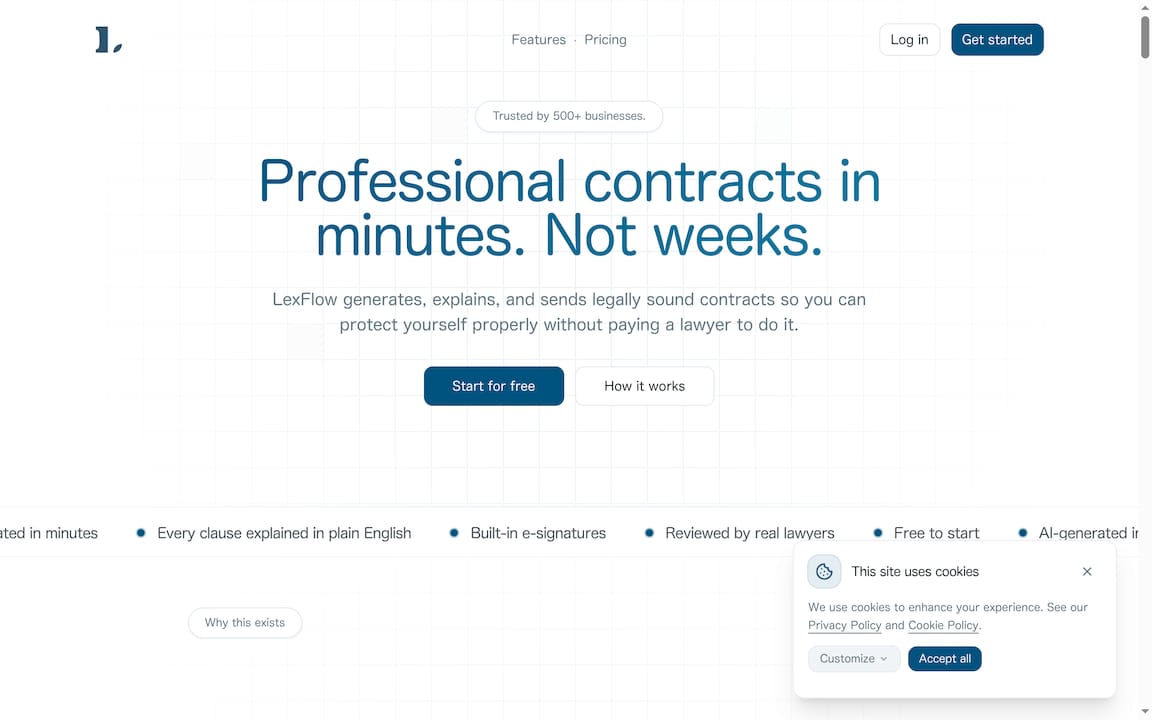
LexFlow lets you create contracts in minutes using AI-powered templates built for startups, freelancers, and small businesses. Every clause comes with a plain-English explanation so you always know what you are agreeing to. From founders’ agreements to SaaS legal templates, LexFlow covers the documents you need most. Built-in e-signatures, a secure document vault, and automated workflows mean you spend less time on paperwork and more time building. Start with a free template and see how fast legal protection can be.
Frequently asked questions
What legal documents are most critical for startups?
Founders’ agreements, NDAs, employment contracts, IP assignments, and privacy policies are the most crucial early documents. Founder disputes over equity and roles cause 13% to 65% of startup failures, making the founders’ agreement the single most important document to have in place first.
How does legal protection impact funding for startups?
Startups with patents and clean legal documentation attract more investors and have higher acquisition rates. Early patent filing is directly linked to higher total funding, especially before a company’s first institutional round.
What compliance issues should startups watch for?
GDPR, CCPA, labor classification rules, and data collection practices are the most common compliance traps. Regulatory challenges contribute to 8% to 18% of startup failures, and enterprise customers expect compliance documentation before signing deals.
Can startups manage legal protection affordably?
Absolutely. Modern contract platforms and AI-generated templates make legal protection fast and cost-effective for small teams. Common legal mistakes like contractor IP issues and SAFE dilution are entirely preventable with the right tools in place from day one.