Why contracts matter for startups: protect growth in 2026

Why contracts matter for startups: protect growth in 2026
TL;DR:
Proper contracts protect startups from ownership disputes, legal risks, and financial losses.
Key agreements include founders’, IP assignment, employment, client, and NDA contracts.
Managing contracts efficiently with templates and tools is essential for growth and legal security.
A $1B acquisition nearly collapsed because of unclear founder equity. That was GM’s purchase of Cruise, and the deal almost fell apart over something every founder can control: a well-written operating agreement. Most early-stage founders treat contracts as an afterthought, something to handle once the product ships or the team grows. That mindset is expensive. Contracts are not legal formalities. They are the structural backbone of your business, protecting your intellectual property, your equity, your revenue, and your relationships. This guide breaks down why contracts matter, which ones you need, and how to manage them without drowning in legal fees.
Table of Contents
The hidden risks: Why startups can’t ignore contracts
Essential contracts every founder needs
Mistakes and myths: What founders get wrong about contracts
How to make contracts manageable (even without lawyers)
A startup founder’s take: Contracts as infrastructure, not cost
Fast, affordable contract management for startups
Frequently asked questions
Key Takeaways
Point | Details |
|---|---|
Contracts prevent disaster | Missing contracts can destroy deals, trigger lawsuits, and cripple startups from the start. |
Founders need basics | Prioritize founders’ agreements, IP assignments, and employment contracts for core protection. |
Templates aren’t always enough | Generic contracts often fail state requirements and expose your company to risk. |
Smart management saves money | Effective contract tracking and review help avoid costly mistakes and lost revenue. |
Contracts build investor trust | Early, solid contracts signal maturity and prevent due diligence failures during fundraising. |
The hidden risks: Why startups can’t ignore contracts
Most founders only discover the value of contracts after something goes wrong. A co-founder walks out and claims half the IP. A contractor builds your core product and then argues they own the code. A client refuses to pay because the scope was never clearly defined. These are not edge cases. They are the most common ways startups lose momentum, money, and sometimes the entire company.
Contracts protect startups from IP loss, founder disputes, and lawsuits that can drain resources before you ever reach product-market fit. The risks are not abstract. Legal issues cause 18% of startup failures, and founder conflicts trace back to contract gaps more often than any other single cause.
Here is what you are actually risking without proper agreements in place:
IP ownership disputes when contractors or co-founders claim rights to your product
Equity conflicts that surface during fundraising or acquisition talks
Scope creep and non-payment from clients with no written agreement
Regulatory exposure from employment arrangements that do not meet state requirements
Loss of investor confidence when due diligence reveals missing documentation
“Contract issues contribute to 18% of startup failures, yet most founders treat legal agreements as optional until it’s too late.”
The financial exposure is real too. Poor contract management advice and sloppy agreements connect directly to accounting mistakes for startups because untracked obligations and unclear payment terms create cash flow problems that compound quickly.
Building legal protection for startups from day one is not about being overly cautious. It is about making sure the business you are building actually belongs to you. And contract review to prevent risks is one of the highest-leverage habits a founder can build early.
Now that you see the stakes, let’s break down what getting contracts right really means.
Essential contracts every founder needs
Beyond identifying risks, knowing which contracts address them is key. Not every agreement carries the same weight, but a handful of documents form the foundation of a legally sound startup.
Essential contracts include a Founders’ Agreement, IP Assignment, and Employment Agreements, along with client contracts and NDAs. Each one closes a specific vulnerability.
Founders’ agreement defines equity splits, roles, vesting schedules, and what happens when someone leaves. Without it, a Cruise-style $1B dispute over unclear founder equity can derail even the most promising deal.
IP assignment agreement transfers ownership of any work created by contractors or employees to the company. This is non-negotiable before fundraising.
Employment and contractor agreements set expectations, protect trade secrets, and define non-compete terms where enforceable.
Client service agreements lock in scope, payment terms, deliverables, and dispute resolution so you get paid for what you actually deliver.
NDA (non-disclosure agreement) protects sensitive information shared with partners, investors, or vendors.
Contract type | Primary risk it covers | When you need it |
|---|---|---|
Founders’ agreement | Equity and role disputes | Before building anything |
IP assignment | Ownership of product/code | Before hiring contractors |
Employment agreement | Team and IP protection | First hire |
Client contract | Non-payment, scope creep | Every client engagement |
NDA | Confidentiality breach | Any sensitive conversation |
For founders drafting their first agreements, agency contract drafting resources and a solid contract templates guide can help you move fast without starting from scratch.

Pro Tip: Never use a generic template without customizing it for your state and business model. What is enforceable in Delaware may not hold in California or Texas.
Mistakes and myths: What founders get wrong about contracts
Even when founders have contracts, errors and assumptions can sabotage their protection. The most dangerous myth is that contracts are either too expensive or unnecessary in the early stage. Both beliefs lead to the same outcome: a preventable crisis.
Templates fail state laws and skipping contracts multiplies future costs by 10x. That is not a hypothetical. Founders who cut corners on agreements early often spend far more fixing problems during fundraising, acquisition, or litigation.
Here are the most common contract mistakes founders make:
Using unmodified templates that do not reflect local law or your specific deal terms
Leaving IP unassigned from contractors, which can kill ownership claims at your Series A
Vague scope language in client agreements that invites disputes over deliverables
No vesting schedule in the founders’ agreement, leaving equity exposed if someone exits early
Missing governing law clause, which creates confusion about which state’s rules apply
The earnout case study between J&J and Fortis Advisors shows what vague “best efforts” language actually costs. A $1B dispute arose entirely because the contract did not define what “best efforts” meant in measurable terms. Vague contract terms and unassigned contractor IP are the two issues most likely to surface at the worst possible moment.
Approach | Risk level | Compliance | Likely outcome |
|---|---|---|---|
DIY generic template | High | Often non-compliant | Disputes, unenforceability |
Customized template | Medium | State-specific | Solid baseline protection |
Custom legal contract | Low | Fully compliant | Strong, enforceable agreement |
Understanding legal template pitfalls and following solid contract compliance tips will save you from the most common traps.
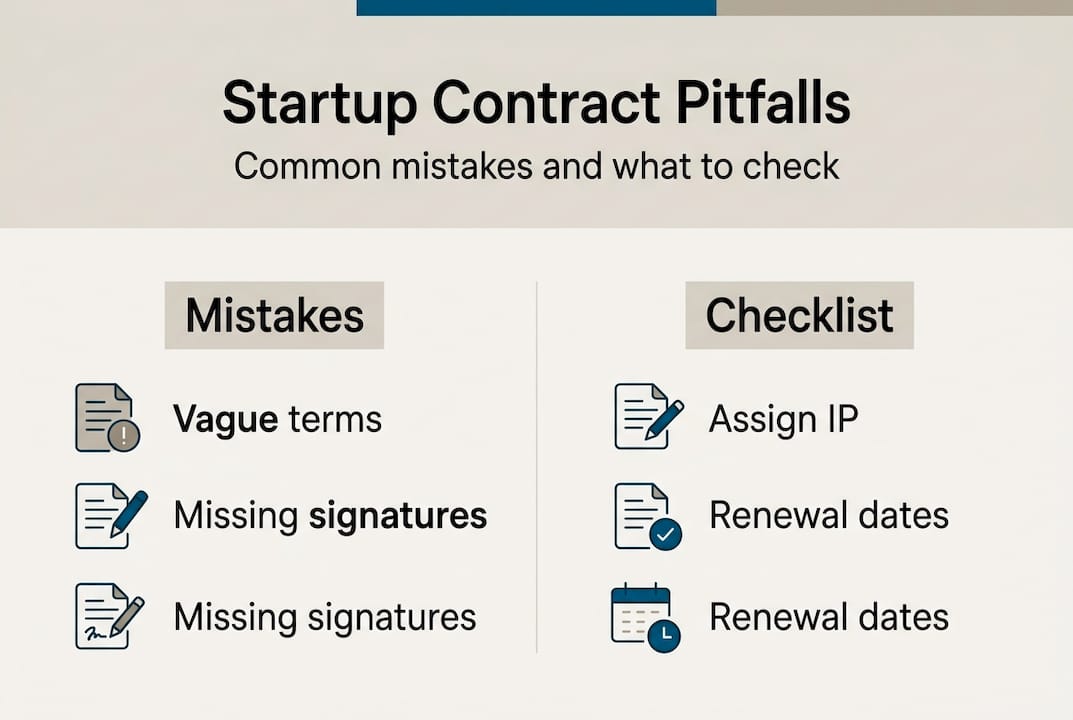
Pro Tip: Before any fundraising round, audit every contractor agreement to confirm IP has been formally assigned to the company. Investors will check, and gaps will delay or kill the deal.
How to make contracts manageable (even without lawyers)
It is not just about having contracts. It is about managing them efficiently, even on a budget. The good news is that founders do not need a legal team to build a solid contract workflow. They need a clear process and the right tools.
Here is a practical contract workflow you can implement right now:
Identify your contract needs based on your current team, clients, and vendor relationships.
Select reputable templates that are customizable and jurisdiction-specific.
Customize each agreement for your specific deal terms, state law, and business model.
Get legal review for high-value or high-risk agreements before signing.
Use e-signature tools to execute agreements quickly and create a clear audit trail.
Store all contracts in a centralized, searchable location so nothing gets lost.
Track key obligations and deadlines so you never miss a renewal, payment, or deliverable.
Track obligations to avoid 9% revenue leakage. That number adds up fast when you have multiple client and vendor agreements running simultaneously. And contract negotiation takes 39 days on average for business services, with legal involved in 75% of deals. Companies that streamline this process cut legal involvement to 32% and close faster.
Knowing when to bring in a lawyer matters too. You do not need one for every agreement, but you do for these:
Fundraising documents and term sheets
Acquisition or merger agreements
Licensing deals with significant revenue attached
Employment contracts in states with complex labor laws
Any agreement where a mistake could cost more than legal fees
Connecting your contract management for startups process with your financial tracking also matters. Missed contract obligations show up directly in your books, and startup bookkeeping best practices include tracking contract-linked revenue and expenses as a core discipline.
Pro Tip: Set calendar reminders for every contract renewal, expiration, and payment milestone. Most revenue leakage does not come from bad deals. It comes from forgotten obligations.
For any agreement that requires formal execution, understanding legally binding signatures ensures your documents hold up if challenged.
A startup founder’s take: Contracts as infrastructure, not cost
Here is the perspective most legal articles skip: contracts are not a cost center. They are infrastructure. Just like your cloud hosting or your payment processor, contracts are what make everything else work reliably.
Founders who treat legal agreements as a one-time checkbox tend to discover their mistake at the worst possible moment, during a raise, an acquisition, or a client dispute. The startup legal safeguards you put in place today are what give investors, clients, and partners confidence in your business tomorrow.
“Skipping contracts saves short-term but multiplies future costs 10x.”
The founders who move fastest are not the ones who skip legal work. They are the ones who build repeatable systems for it. A well-managed contract library is a competitive advantage. It signals that your business is real, organized, and trustworthy. And the role of accountants in early-stage startups often includes flagging contract-related financial risks, which means your legal and financial systems need to talk to each other.
Stop thinking of contracts as something lawyers handle. Start thinking of them as something your business runs on.
Fast, affordable contract management for startups
If this article made one thing clear, it is that contracts are not optional and managing them does not have to be painful or expensive. Founders deserve tools that work as fast as they do.
LexFlow is built specifically for founders, freelancers, and small business owners who need legally sound contracts without the legal bill. You can create and sign contracts in minutes using AI-powered templates tailored to your jurisdiction. Every clause comes with a plain-English explanation so you actually understand what you are signing. Built-in e-signatures, secure document storage, and streamlined workflows mean you go from draft to done without the back-and-forth. Read the contract legal disclaimer to understand how LexFlow supports your legal needs. Start protecting your startup today.
Frequently asked questions
What are the most important contracts for a startup to have?
Key contracts include a founders’ agreement, IP assignment, employment agreements, and client or vendor contracts. These cover the most common sources of startup disputes and protect your core assets.
Why are generic contract templates risky for startups?
Generic templates often miss state-specific legal requirements, which can make agreements unenforceable or leave critical gaps that surface during disputes or due diligence.
How can founders create contracts without hiring a lawyer?
Founders can use reputable, customizable templates and track obligations to avoid revenue leakage, bringing in legal review only for high-value or high-risk agreements.
What happens if contract obligations are missed?
Ineffective contract management costs companies 9.2% of annual revenue on average, and missed obligations can also create legal liability or threaten company ownership.
How do contracts impact startup fundraising?
Strong early contracts signal operational maturity to investors and prevent 60 to 90% of deal failures that occur during due diligence, making them one of the highest-leverage investments a founder can make.